

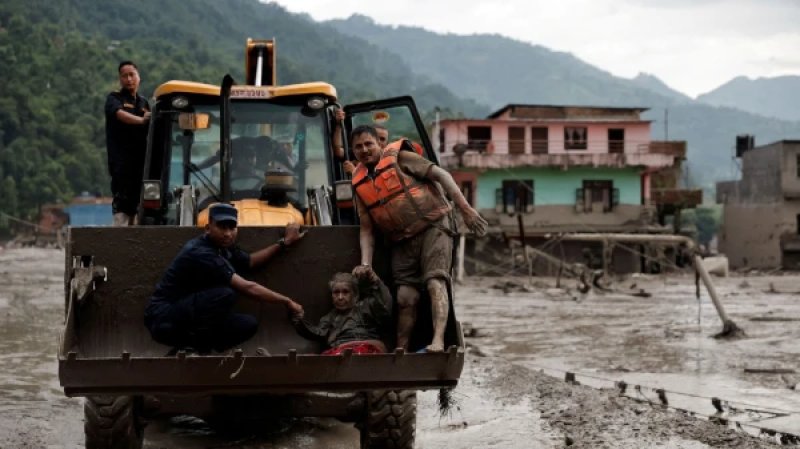
In Tibet, 558 people remain missing, while in neighboring Nepal, more than 1,400 are unaccounted for, including hundreds of foreign tourists and residents of Latvia. The threat of repeated flooding, heavy rains, and mud-covered roads complicate the search for hundreds of missing persons in Tibet two days after massive floods hit the border between China and Nepal. The first rescuers arrived in the most affected area of Tibet on Friday afternoon, Chinese state media reported. This came more than 50 hours after a torrent of mud and debris struck the border area of Nepal and Tibet on Wednesday morning. Data released in China indicates that by Friday noon, the death toll from the mudslide in Tibet had risen from three to five, while 558 people are still listed as missing. In Nepal, at least 547 people have died as a result of sudden flooding caused by a glacier collapse. More than 1,400 people, including hundreds of foreign tourists, are still considered missing. Among the missing are residents of Latvia. Chinese officials have warned of significant difficulties in conducting the rescue operation, as the border region continues to face new natural disaster threats. Chinese President Xi Jinping held a high-level meeting regarding the rescue operation, which he said "faces great difficulties." "Numerous hidden threats related to glaciers, glacial lakes, and geological disasters still persist in the surrounding area," the state news agency Xinhua quoted the country's leaders as saying. After the mudslide on Wednesday, a massive lake formed upstream of the river, raising concerns that it could overflow and lead to new severe flooding. State broadcaster CCTV reported that the rescue operation was temporarily suspended on Friday due to the risk of "secondary disasters" that could be caused by the lake overflowing. According to footage captured by a military drone, approximately "50,000 cubic meters of ice debris" entered the lake. Several hours later, another report from CCTV stated that the risks "are gradually decreasing" as water from the lake "is flowing out naturally, and the outflow capacity exceeds the incoming water volume." The U.S. Geological Survey reported that the disaster was caused by a glacier collapse, which led to a flow of ice debris. On Thursday and Friday, Chinese media showed photos and videos indicating that roads up to three kilometers from the border are covered in mud, with some areas having a layer of at least one and a half meters. Rescuers have to navigate through broken branches and stones to approach the epicenter of the disaster. Foreign journalists largely do not have the opportunity to be in the Tibet Autonomous Region. They are usually only allowed to visit this area as part of organized government trips. On Friday, communication in the most affected area was still absent. Rescue efforts may also be complicated by heavy rains and thunderstorms forecasted in the region until Monday. "The risk of natural disasters is relatively high," warned the local meteorological bureau, as the ongoing rains could trigger new sudden floods and landslides. CCTV reported that by Friday, 499 Chinese citizens and 555 foreigners had been evacuated from the disaster zone. The rescue operation at the border of Tibet and Nepal continues amid the ongoing threat of new natural disasters. Hundreds of people are still listed as missing, and the rains and thunderstorms predicted until Monday could again trigger sudden floods and landslides, further complicating the work of rescuers.
