

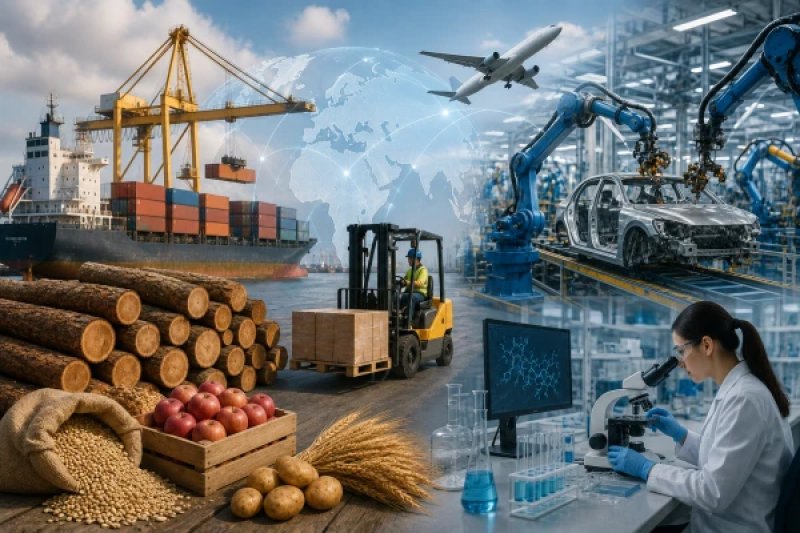
According to him, economic development is not just about producing more of the same goods. The country needs to gradually transition from low value-added products to more complex and expensive ones. It is this structural transformation that changes the economy and allows for increased labor productivity and income levels. Today, the most complex products are concentrated primarily in electronics, chemical and pharmaceutical industries, machine engineering, and vehicle manufacturing. The development of these sectors requires modern technologies, skilled specialists, investments, and effective institutions. Countries that specialize in such products — for example, Germany, Switzerland, and Japan — typically exhibit high labor productivity and high wages. Equally important is the export of services — from education, healthcare, and transportation to marketing, artificial intelligence, and cybersecurity software. Without the development of modern services, the economist notes, it is impossible to complicate the industry itself. At the other end of the scale are raw materials, agricultural and food products, woodworking, and textiles. It is in these categories that the simplest goods are most often found. Countries whose economies are significantly oriented towards such products usually exhibit lower productivity and wages. The economist emphasizes that Latvia should not close food enterprises or the woodworking industry simply because their products have relatively low added value on average. The task is different — to learn how to produce more expensive and technologically complex products from agricultural raw materials and wood that are in demand in the global market. A developed agricultural sector does not hinder the development of electronics, the chemical industry, or machine engineering. For example, the United States is the world's largest exporter of grains, and Norway is a major exporter of fish; however, these products make up only a small part of the total exports of these countries. **Latvia Lags Behind Lithuania and Estonia** To assess Latvia's competitiveness, Krasnopjorovs suggests comparing it with eight nearby EU countries — Lithuania, Estonia, Poland, the Czech Republic, Hungary, Romania, Slovakia, and Slovenia. The income levels in these countries are approximately 75–91% of the EU average. Latvia is at about 70%, so the indicators of these states, according to the economist, are a realistic benchmark for the next 10–20 years. In the global ranking of the complexity of commodity exports, Latvia ranks 39th. Estonia is in 28th place, and Lithuania is in 30th place. Moreover, among the considered group of EU countries, Latvia has remained last since 2012. After joining the European Union, Lithuania rose in this ranking by 16 positions, Estonia by six, while Latvia dropped by two positions.
