

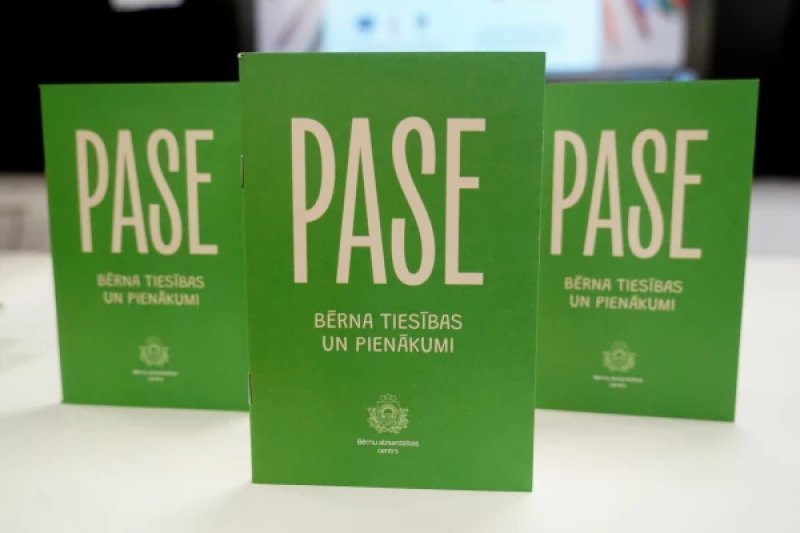
The Child Protection Center (BAC) hopes that the 'Passport of Rights and Responsibilities for Children', which all first graders in Latvia will receive, will help facilitate a conversation between children, parents, and educators about school life, relationships, rights, responsibilities, and safety. Representatives of BAC announced this at a press conference on Monday. Liāne Kauliņa-Bandere, Deputy Director of BAC for Development and International Cooperation, noted that such material has not existed in Latvia until now. The beginning of school life often becomes an emotionally challenging period for a child: after kindergarten, they enter a completely new environment, and it can be difficult to adapt to it.  The new 'passport' is intended to help the child understand what they can expect from themselves and others, as well as learn to talk about safety, relationships, and seeking help. It is especially important, emphasized Kauliņa-Bandere, for the child to know whom to turn to if problems arise at school. Children do not always immediately tell adults about what has happened to them, and conversations with parents sometimes never start. The 'passport' can serve as a reason for such a conversation: the child draws attention to a specific topic or depicted situation and begins to discuss it with an adult. The material is intended not only for children but also for parents and educators. ### Parents Will Receive Instructions Along with the 'passport', parents, guardians, and foster families will receive methodological recommendations for its use. These contain practical advice on how to engage in conversation with the child, examples of questions, and recommendations that connect the situations presented in the 'passport' with the everyday life of the student. BAC advises against trying to study all the material at once. It is recommended to dedicate about five to ten minutes to one conversation and discuss two to four pages. First, the adult and child are encouraged to look at the illustration together, then read the text, relate the described situation to the child's everyday experience, and discuss possible courses of action. Representatives of the Child Protection Center emphasized that conversations on important topics for the child should begin in advance, without waiting for the age when the child decides to talk about them. The task of parents is to help the child engage in the conversation, support them, and explain possible actions while simultaneously creating a sense of safety: the child should understand that they have the right to ask questions, express doubts, and talk about what is happening. ### What Will Be Explained to First Graders The 'passport' explains in a language understandable to children that they have the right to be safe, learn, rest, express their opinions, receive help, and be protected from violence. At the same time, children are reminded of their responsibilities: to respect others, take care of belongings, follow rules, and behave responsibly online. Children are also encouraged to identify adults they trust and to always tell them if someone causes them harm, scares them, or makes them feel uncomfortable. The material specifically emphasizes that a child does not need to 'earn' their rights. However, through their actions, they help protect the rights of others. ### Children Fear Parents' Reactions to Grades Anda Saulīna, Deputy Director of BAC for Advisory Support, Methodological Guidance, and Analytics, reported that children call the helpline also due to anxiety related to school and fear of their parents' reactions to their grades. Therefore, cooperation between parents, educators, and the children themselves is especially important. BAC representatives acknowledged that educators sometimes may say inappropriate things to a child. If teachers have questions or doubts, they can also contact the helpline. This option is also available for parents. The helpline for children and adolescents **116111** operates 24/7 and free of charge, providing psychological and informational support to children, adolescents, and their parents. Help is also available in an online chat on the Center's website. If there is a threat to the life, health, or safety of a child, it is necessary to call **112**. ### Teams of Specialists Will Be Sent to Schools At the press conference, BAC announced another upcoming initiative. The Center plans to assist educational institutions in identifying and reducing risks associated with problematic behavior in children and addictions. It is anticipated that special teams, including a specialist in the field of narcology, will visit schools. Educators will be provided with practical tools for working with children at risk of addiction. BAC promises to provide more detailed information after developing specific solutions. The 'Passport of Rights and Responsibilities for Children' and methodological recommendations will also be available in electronic form — they can be downloaded for free from the BAC website in the parents' section. The materials were developed as part of a project implemented by the Child Protection Center under the European Social Fund Plus, aimed at enhancing professional qualifications in child rights protection and strengthening the accountability of their legal representatives. **The total cost of the project is 7.92 million euros**, of which 6.73 million euros is financed by ESF+, and another 1.19 million euros is allocated from the state budget.
