

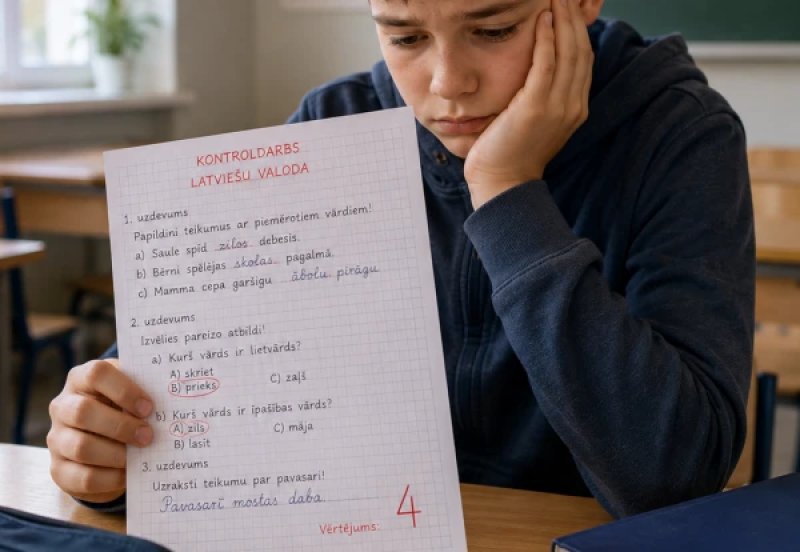
If in the morning of August 31 it was planned to allow students in grades 7–9 to correct up to half of their final grades, the new version of the project has lowered the threshold to one third. At the same time, the new rules are intended to be applied to students starting from the 4th grade. The government is expected to make a final decision on September 1. Just on Monday morning, the draft amendments stipulated that students in grades 7–9 would be able to correct at least one, but no more than half of the summative grades received. However, the document was changed before the government meeting. In its latest version, it is proposed to allow students in grades 4–9 to correct no more than one third of the summative grades received in the respective subject. Each grade selected for improvement can only be corrected once. When calculating one third of the total number of summative grades, mathematical rounding to the nearest whole number will be applied. At the same time, schools will be able to determine the specific procedure for correcting grades independently. In particular, the educational institution will decide which specific grades the student will be able to improve, how this can be done, and within what time frame. ### Different Rules for Students in Grades 1–3 Students in grades 1–3 are expected to be given the opportunity to improve their summative grades in subjects throughout the school year. Each such grade can also be corrected once. The annotation to the project states that for children of this age, the approach to improving grades should primarily focus on timely support directly in the learning process. Special attention is expected to be paid to reinforcing basic skills and facilitating the child's progress in learning. In the previous version of the project, the rules looked different: it was assumed that students in grades 1–6 would be provided with the opportunity to improve at least one summatively assessed result for each subject during the school year. The Ministry of Education and Science (IZM) explains that in grades 1–3, the opportunity for correction should become part of the support for the child during the learning process. Primarily, this concerns reinforcing basic skills and stimulating further progress for the student. In addition, students are expected to be given the opportunity to improve the summative grade for achieving a learning outcome, which is indicated in the report card. ### Why a Limitation is Introduced for Older Students For students in grades 4–9, it is proposed to find a balance between the opportunity to improve learning outcomes and the necessity to maintain the value of summative assessment. The Ministry of Education explains that the limitation to one third is introduced so that grade corrections do not effectively turn into a parallel system of re-evaluation. At the same time, schools will be required to ensure equal rights for all students to improve their summative grades—regardless of their overall academic performance or the grade the student initially received. Correcting a grade should be viewed as a continuation of the learning process. It is expected to be linked to feedback from the teacher, completing additional educational assignments, attending consultations, or other activities aimed at enhancing the student's knowledge and skills. ### Separate Procedure for Children with Special Needs Special rules are provided for students with special needs, for whom an individual educational program has been developed. The procedure for improving their summative results will be applied taking into account the support provided in the individual plan, as well as the specifics of organizing the learning process for the particular child. ### Abandoning the Mandatory "Weight" of Grades The draft amendments also provide for another significant change—the abandonment of the mandatory principle of weighting summative grades. In the future, teachers will be able to assign different weights to various summative grades if it is pedagogically justified. However, the specific procedure will have to be established by the school itself. After the amendments come into force, educational institutions will have to clarify their internal assessment rules. Schools will retain autonomy in organizing the correction of specific grades, but will be required to ensure objectivity in assessment so that the final grade reflects the student's actual academic achievements. ### Decision on September 1 The issue of changes to the state standard of basic education will be considered by the Latvian government **on Tuesday, September 1**, according to the agenda of the meeting. Thus, the proposed system has become stricter compared to the initial version: **students in grades 4–9 will be allowed to correct a maximum of one third of their summative grades instead of the previously discussed possibility of correcting up to half.** At the same time, schools will receive significant freedom in determining how the retake process will take place, while younger students will retain a more flexible approach primarily focused on assistance in mastering the material.
