

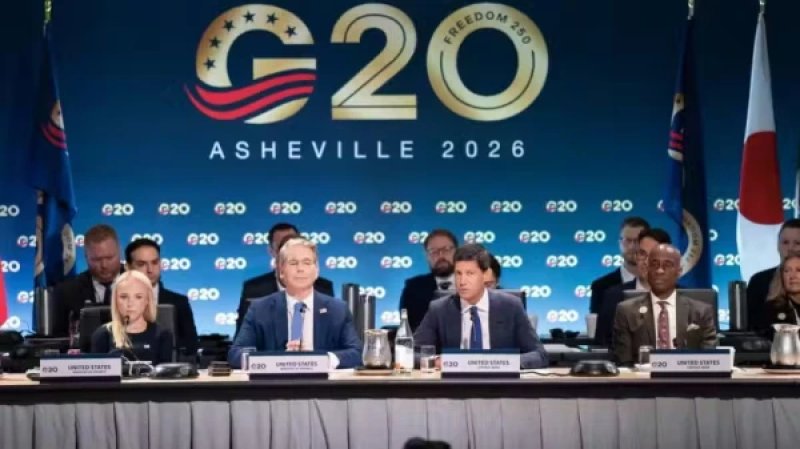
The meeting of finance ministers and central bank governors of the G20 countries took place in Asheville, North Carolina. Russia was represented at the negotiations by Finance Minister Anton Siluanov, as reported by [Entrevue](https://entrevue.fr/ru/monde/g20-finance-les-etats-unis-defendent-la-presence-de-la-russie-malgre-les-critiques-europeennes/). For the head of the Russian Ministry of Finance, this was his first personal participation in a meeting of this format since the start of Russia's full-scale military actions against Ukraine. The invitation to the Russian minister caused discontent among some Western delegations. Canada and several European countries stated that they do not consider it possible to treat Russia as a regular participant in international meetings while the war in Ukraine continues. German Finance Minister Lars Klingbeil expressed particularly harsh views. He rejected the possibility of perceiving the presence of the Russian delegation as a sign of gradual normalization of relations with Moscow. ## Washington Advocated for Maintaining Dialogue The American side, on the contrary, publicly defended the decision made. U.S. Treasury Secretary Scott Bessent stated that the presence of Russian representatives at such meetings allows for maintaining the possibility of dialogue. Thus, Washington demonstrated that it does not intend to support the complete exclusion of Moscow from key multilateral international formats, despite calls from several European countries to continue the diplomatic and economic isolation of Russia. Disagreements surrounding the Russian delegation effectively demonstrated the differences in the approaches of Western countries. While some European countries believe it is necessary to avoid steps that could be perceived as a return to previous relations with Moscow, the American administration emphasizes maintaining platforms for negotiations. At the same time, Russia's presence at the G20 meeting does not in itself imply the lifting of sanctions or official normalization of relations between Moscow and Western countries. ## G20 Failed to Reach Agreement on China Russia was not the only issue on which participants at the meeting faced serious disagreements. The session concluded without the traditional joint communiqué. This time, the reason was contradictions surrounding China, trade imbalances, and Beijing's economic policy. The other 19 participants supported a draft document that contained a call to reduce market distortions. However, China did not agree with the proposed wording. Since decisions of this level require consensus, it was not possible to adopt a unified final communiqué. As a result, the United States, as the host country, published a separate statement from the chair instead of a common document from all participants. At the same time, the wars in Ukraine and the Middle East were not directly mentioned in the final statement. The meeting in Asheville ultimately demonstrated several fault lines within the G20. European countries and the U.S. diverged in their assessment of how far to go in isolating Russia, while the dispute over China's economic policy prevented the adoption of a joint communiqué. Washington made it clear that despite the ongoing war and pressure from European allies, the U.S. considers maintaining direct dialogue with Moscow at the G20 necessary.
