

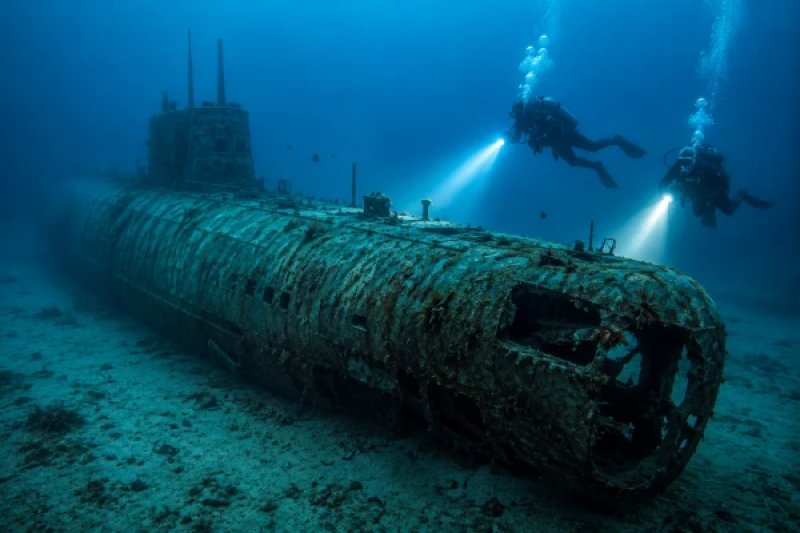
According to Euronews, citing the German agency dpa, this concerns two submarines of the German Navy that sank in 1941 and 1943. The information about the discovery was confirmed by historian Christian Lubke from the German War Graves Commission. Deutsche Welle notes that both findings were made by Polish researchers of the Baltic Sea. ## Searched for Several Years and Found on the Third Attempt The submarine U-583 was discovered on July 15 by members of the Polish association of shipwreck researchers Stowarzyszenie Wyprawy Wrakowe in collaboration with the hydrographic company Geoings Polska. According to Deutsche Welle, it is located east of the island of Bornholm, at the border of the Polish economic zone. The depth in the area of the submarine's discovery is about 70 meters. The search for U-583 was not the first — the third expedition was successful. The head of the Polish association, Piotr Witychowski, stated that the hull of the submarine is very well preserved and almost intact, although it is heavily entangled in fishing nets. The second submarine — U-649 — was discovered a little later. The exact coordinates of its location are not yet disclosed. ## U-583 Sank in Just a Few Minutes Both submarines did not perish in battle. As **Euronews** writes, the cause of their sinking was collisions with other German submarines during training sorties. U-583, built in 1940 at the Hamburg shipyard Blohm & Voss, sank on November 15, 1941, after colliding with U-153. The accident developed so quickly that the submarine filled with water and sank to the bottom in a matter of minutes. All 45 sailors on board perished. Their average age was about 24 years. ## 11 People Survived from the Second Submarine U-649 met a similar fate on February 24, 1943. It also collided with another German submarine in poor visibility conditions. According to Euronews and Deutsche Welle, this time parts of the crew managed to survive. Eleven people survived. Some sailors were able to leave the submarine through the torpedo tubes, using emergency equipment. However, 35 crew members died. The average age of the sailors was about 23 years. Thus, the two discovered submarines became the site of death for a total of **80 people**. ## There Are No Plans to Raise the Submarines There are no plans to raise U-583 and U-649. As Euronews notes, torpedoes and other explosive munitions may still be inside, and the sunken vessels effectively serve as military graves. There is also another problem — military souvenir hunters. The sunken German submarines attract divers who may attempt to enter in search of preserved items. U-649 is considered particularly vulnerable: it has an open hatch and one of the torpedo tubes, which facilitates access inside. According to Deutsche Welle, the German War Graves Commission is considering asking Polish authorities to establish no-diving zones around the sunken submarines. This should protect the sailors' burial sites from potential looting. There are also no plans to raise the remains of the deceased to the surface.
