

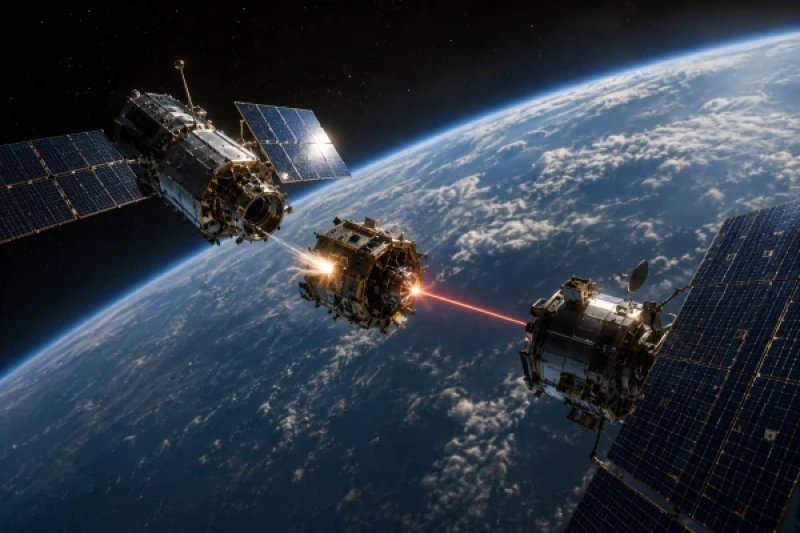
Refueling in the vacuum of space is also being tested to expand the maneuverability capabilities of satellites. Russia is acting in a similar direction, reportedly developing a satellite capable of deploying nuclear weapons in space. In June, a small device was launched from a secret Chinese unmanned "spaceplane." After flying around another Chinese satellite in an orbital zone filled with commercial and military satellites, it returned to base. Little is known about this mission, but the U.S. has a similar unmanned device resembling a small shuttle—the experimental orbital aircraft Boeing X-37, notes Reuters. Both programs reflect the preparations of Beijing and Washington for a potential military conflict in space, according to an analysis of documents, tracking of space objects, and interviews with current and former military officials. A year ago, the U.S. and the U.K. demonstrated their capabilities to China in their first joint operation. When a Chinese satellite (likely a spy satellite) passed within 83 km of a British satellite (considered close by space standards), the U.S. directed its satellite toward the allied one. This "was almost certainly a strategic signal to China" to demonstrate the unity and potential of the allies, as well as to warn against interference with the British satellite's operations, commented former high-ranking RAF officer Andrew Turner, now a consultant on space issues. The same opinion was expressed by two other military-space experts. Satellites have been providing military personnel on Earth with communication, navigation, and intelligence for decades. But now they are increasingly seen as active combat systems capable of maneuvering, disrupting the operations of enemy satellites using radio jamming or lasers, and capturing spacecraft, writes Reuters. Space is becoming "exceedingly important" not only for supporting military operations on Earth but also for ensuring their outcomes, said then-head of the U.K. Space Command, Major General Paul Tedman, in April. The head of U.S. Space Command, General Stephen Whiting, has repeatedly warned that adversaries are developing means to strike U.S. space assets in the early stages of a potential conflict on Earth. Therefore, he believes it is necessary not only to protect American systems but also to be prepared to threaten enemy assets and, if necessary, attack them: "We must be well-prepared for conflict in space. And if deterrence fails, we will fight and win." China is rapidly increasing both the number of satellites and the complexity of missions. Its satellites have demonstrated what American military officials have called orbital "dogfights," during which several satellites maneuver synchronously in close proximity to each other. They have also shown the ability to capture decommissioned devices and transfer them to another orbit. Last year, China reportedly attempted to conduct refueling in orbit, a U.S. Space Forces representative revealed. Satellites have the fuel reserve with which they are launched, so the ability to replenish it and continue maneuvering could determine whether a spacecraft is a "hunter" or "prey." Preparations to combat satellites are also being made from the ground. In June, the U.S. Space Forces reported the deployment of ground-based electromagnetic weapons developed by L3Harris Technologies, designed to disable or disrupt enemy satellites. The U.S., China, and Russia operate maneuverable satellites capable of approaching other spacecraft and conducting inspections. However, Washington has also claimed since 2024 that Russia is developing nuclear anti-satellite weapons. Their use could lead to the destruction and gradual failure of up to 80% of satellites operating in low Earth orbit (the distance from 160 km to 2000 km, where most artificial satellites orbit Earth), as shown by the results of the first exercises conducted by the U.S. this spring, reports The Moscow Times.
