

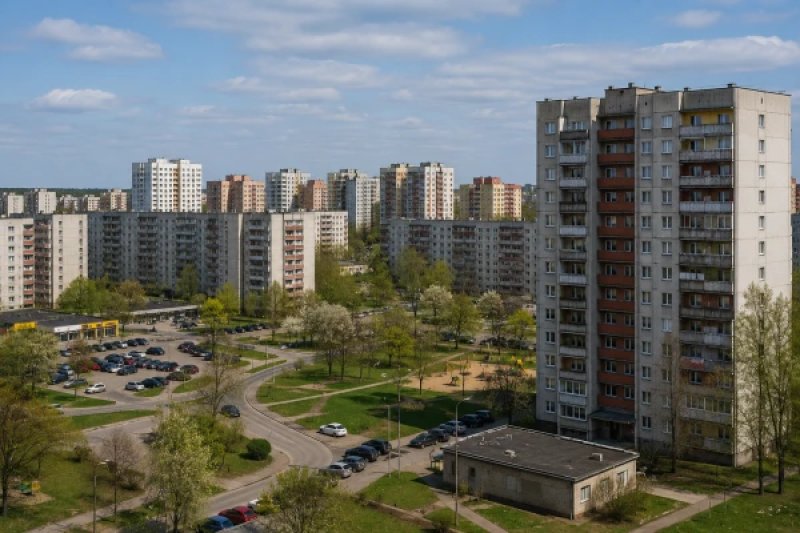
The government has postponed the consideration of amendments prepared by the Ministry of Justice, which are ultimately intended to abolish the legally established fee for using someone else's land. The reason for the delay is quite mundane: the Ministry of Finance has raised objections to the bill, and it has been sent back for clarification. However, the authorities have not abandoned the idea itself. If the amendments are ultimately adopted in their current form, the minimum rate — 4% of the cadastral value of the land per year — will remain only until the end of 2031. Moreover, on top of this amount, apartment owners will have to additionally compensate the landowner for property tax. And then comes the most interesting part. After December 31, 2031, the state intends to completely withdraw from regulating this fee. How much to charge for the land under the house will have to be negotiated between landowners and apartment owners. If they cannot agree — welcome to court. At the same time, even before 2031, four percent will effectively become only the lower limit. The landowner will be able to demand more, and if the residents do not agree — try to achieve a higher fee again through the court. Why was it decided to change the rules at all? For this, we must thank the Constitutional Court. In December last year, it declared the current system unconstitutional: after a lawsuit was filed by landowners who believe that the owners of buildings located on their land are paying them too little. Currently, the law establishes a fee of 4% of the cadastral value of the land per year. The Constitutional Court decided that in some cases, such a fee is insufficient, recognized the current order as unconstitutional, and obliged lawmakers to come up with a new one. On paper, the Constitutional Court's decision sounds impeccable: it is necessary to achieve a "fair balance" of interests between landowners and building owners. But in practice, the scales have tipped quite definitively — in favor of landowners. Meanwhile, on the other side are the owners of approximately 110,000 apartments. Among them are many people for whom a small apartment in some Khrushchyovka is their only somewhat serious property. They did not choose the land under their house, but they are obliged to pay for it to the owner. And now the state has to rewrite the law at the behest of the Constitutional Court precisely because the current fee turned out to be "not profitable enough" for the "barons." The existing norms were allowed by the Constitutional Court to be maintained only temporarily — they will lose their force on January 1, 2027. But apartment owners have an exit. We have already mentioned it several times, and now is the right time to remind again: it is not necessary to pay for the landlord's land forever. Since 2023, apartment owners in a multi-apartment building have the right to buy the land under their house without the consent of its owner. Previously, the landowner could simply refuse to sell the plot or demand a price that was fantastic for the residents. Now, their consent is not required: the law allows apartment owners to initiate the procedure themselves and purchase the land at its cadastral value. To give you an idea of the scale: more than 3,600 multi-apartment buildings stand on someone else's land in Latvia, housing over 110,000 apartments. It would seem that the opportunity for them to get rid of the long-standing "land tax" should have caused a stir. But unfortunately, this did not happen. In the first two years of the new procedure, only 25 buildings completed the process. Several hundred buildings started it, but only these have reached the finish line so far. Why so few? Firstly, residents need to agree among themselves. A decision by the apartment owners is required to initiate the procedure, and gathering the necessary majority in a large building can be challenging. Secondly, the procedure itself is not quick. It is necessary to determine which specific land the building will be purchasing, calculate its value, go through the necessary formalities, after which residents will need to gather the money. And the last point turns out to be the main obstacle for many. The right to buy the land exists — but they have to find the money themselves. Nevertheless, interest is gradually growing. And very quickly. If at the beginning of 2024, only dozens of such cases were being considered by bailiffs across Latvia, by August 24 of this year, applications to initiate the purchase procedure had already been submitted by 490 multi-apartment buildings in Riga alone. However, it is important not to confuse two figures here: 490 buildings are those in Riga that have expressed a desire to start the process, while 25 is the latest found nationwide statistic of buildings that have actually completed the entire process and have already rid themselves of shared ownership. Apartment owners who are still delaying the purchase of the land under their house need to hurry. No one claims that after 2031, the land itself will automatically become more expensive or that the residents' right to buy it will disappear. But it is still not worth waiting. Today, the apartment owner at least knows the rules of the game. There is a legally established procedure that allows them to completely rid themselves of the "land baron" and become, together with their neighbors, the owners of the land under their house. But what will happen in five years, who knows. For now, one thing can be said for sure: if the reform proposed by the Ministry of Justice goes through, after 2031, the state will no longer set even the amount of the fee for using someone else's land. If you cannot agree with its owner on the price — go to court. So isn't it better not to let it come to that? Isn't it wiser to perceive the current delay not as a reason to forget about the problem for a few more years, but as an opportunity to quickly engage in acquiring the land? Start at least by finding out how much it will cost to buy it, talk to your neighbors, convince them — and initiate the procedure. Because the most reliable way not to depend on how much your "land baron" will inflate their demands tomorrow is to ensure that you no longer have to pay them at all.
