

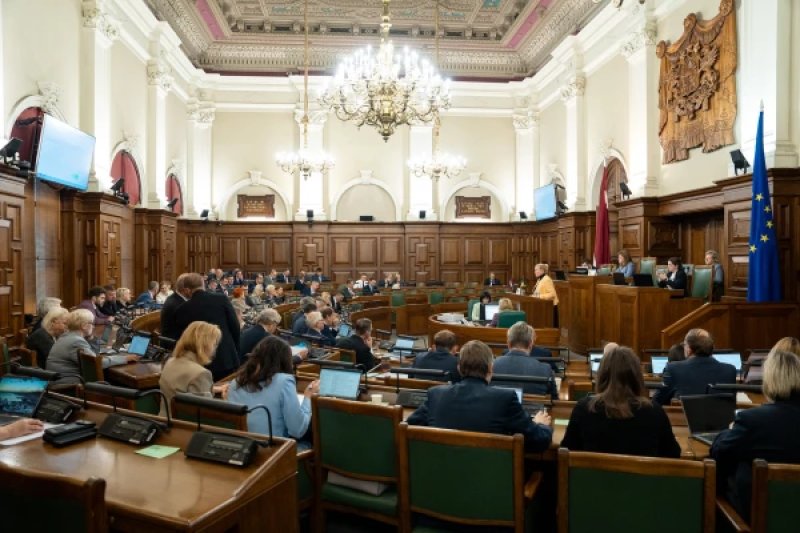
## And finally, I will say It is clear that the servants of the people will try to use the remaining time as productively as possible – September promises to be very hot in a political sense! Moreover, considering the latest ratings, the ruling parties can no longer afford to "sit quietly" – three out of four political forces forming the government are actually on the brink of passing into the next Saeima. According to a survey conducted by SKDS sociologists, in August, 15.2% of voters were ready to vote for the United List, which is part of the government. In turn, their partners in power are stuck at the entrance to the next Saeima: the National Alliance has the support of only 4.5% of voters, "New Unity" – 4.2% of respondents, and the Union of Greens and Farmers is supported by only 2.8% of citizens of Latvia who have the right to vote. It is obvious that only the "united" and their leader – Prime Minister Andris Kulbergs – have gained political advantages from working in the current government. ## When there is nothing left to lose One way or another, the ruling political forces have nothing left to lose – they need to act. And already at the beginning of this week, the "green farmers" came up with a fixed idea to amend the Law on Elections to the Saeima, allowing Latvian citizens abroad to vote by mail for the electoral district in which they were registered before emigration. Currently, all those who vote abroad – by mail or in person (in embassies and consulates) – are "registered" to Riga, meaning they can only vote for party lists in the Riga electoral district. Let us risk assuming that the other political forces in the Saeima will not rush to support this bill before the elections. It can be assumed that in the coming days the same "green farmers" will propose to extend the currently experimental reduced VAT rate to other basic food products. As is known, a reduced VAT rate of 12% currently applies to milk, eggs, chicken meat, and bread. "New Unity" proposed last summer to extend another "experiment" – the payment of 75% of the parental leave benefit to parents, even if they returned to work before the child reaches one and a half years. ## There will be no nationwide presidential elections The opposition is also not idle and this week the Saeima will consider a popular initiative among the people to change the system of electing the head of state. Until now, the president is elected by deputies. Parliamentarians propose to switch to direct elections of the president by all citizens of Latvia. It is noteworthy that the current president Rinkēvičs actively probed the ground on this issue last year – that is, he tried to find out whether it made sense to raise the topic of switching to nationwide presidential elections in this Saeima. Rinkēvičs' summary: there is no majority for this idea in this parliament. In general, the deputies of this Saeima are not supporters of expanding popular sovereignty – even the relatively harmless initiative of Rinkēvičs to slightly ease the procedure for initiating a referendum has long been shelved in the Saeima committee, and it is already obvious that the corresponding amendments proposed by Rinkēvičs will not be adopted in this parliament. As for the amendments to the Constitution regarding the transition to nationwide presidential elections, they will surely be sent to the Saeima committee, where they will be buried. There is no doubt that the next president – in May 2027 – will also be elected by the deputies of the Saeima. ## And even advertising in Russian – will be banned Apparently, even before the elections, the deputies will try to adopt in the final reading the amendments of the National Alliance deputies to the Law on Electronic Media, which provide for a ban on commercial advertising on radio stations in foreign languages. A ban is also planned on the airing of songs in television and radio broadcasts whose performers and/or authors are on the EU sanctions lists. After these amendments were supported in the second reading, many opposition politicians raised concerns that some songs by maestro Pauls, whose performers and authors also ended up on the sanctions lists, could be banned. It is highly likely that the National Alliance will come up with some other amendment in September that limits the use of the Russian language in the public sphere. Although it is becoming increasingly difficult to do so. ## I don’t believe it! The opposition, of course, will also do everything to remind people of themselves. Thus, at the upcoming plenary session, proposals from the opposition to express no confidence in the Minister of the Interior Janis Dombrovskis and the Minister of Communications Richard Kozlovskis will be considered. The opposition does not forget about important tax issues for voters. This Thursday, at the plenary session, deputies will consider amendments regarding the return of overpaid taxes when Latvians purchase medicines and medical devices that are not included in the lists of state-compensated medications and devices. ## Another attempt by the Prime Minister As is known, at the summer extraordinary plenary session, deputies re-approved the new Immigration Law. Recall: initially, the president refused to proclaim it and returned it to the Saeima for revision. However, the deputies did not heed all of Rinkēvičs' recommendations – in particular, they ignored his request to provide for the possibility of obtaining a residence permit for citizens of countries friendly to Latvia in exchange for purchasing real estate. This same proposal was advocated by Prime Minister Kulbergs. If the president does proclaim the law in this form, the prime minister intends to attempt to introduce an amendment to this law in this Saeima – he believes that such a model of "residence permit in exchange for purchasing real estate" will allow the state treasury to attract at least 150 million euros! There is a high probability that the Saeima will manage to adopt in the third and final reading a package of bills as part of the "reform" of oversight of non-bank creditors (financial firms) before the elections. Despite the objections of experts, non-governmental organizations, the Ministry of Economics, and the industry itself, the majority of parliamentarians want to take away from the Consumer Rights Protection Center the functions of oversight over financial companies and transfer them under the supervision of the Bank of Latvia. This will not yield any positive effect – just extra bureaucracy. It cannot be ruled out that before the elections, opposition deputies, to make things even more interesting, will again return to the agenda the "frozen" bill on Latvia's withdrawal from the Istanbul Convention at the request of the president.
