

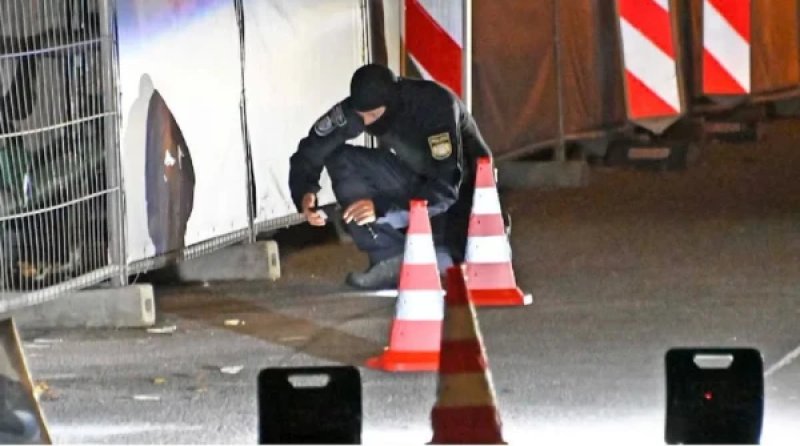
According to data from the BKA, as reported by BILD, there were 163 cases of sabotage or suspicion of sabotage registered in Germany from the beginning of the year until mid-August. For the entire year of 2025, there were 191. Formally, this indicates a decline. However, it is difficult to directly compare these figures: the criteria for accounting and the nature of the attacks themselves have changed. Increasingly, the targets are not random objects, but infrastructure whose disruption can cause maximum effect: railways, energy, communications, airports, military facilities, and defense industry enterprises. According to BILD, citing internal documents from the BKA, there have been 722 incidents involving drones and 1,034 spotted drones in Germany since the beginning of the year. In the same period last year, there were reports of 1,304 incidents and 2,333 devices. However, drones continue to regularly appear near defense enterprises, military bases, and airports, and identifying their operators is only achieved in rare cases. BILD also reports, citing the BKA, that the Federal Public Prosecutor's Office has opened 25 cases of espionage and cyber espionage. An additional 39 episodes with possible political motives are being investigated by the Federal Criminal Police Office itself. This is no longer just a background of concern but a distinct area of work for the police, prosecutors, and counterintelligence. ## Drones with Explosives in Leipzig A special place in this chronicle is occupied by the attempted attack on Leipzig/Halle Airport. On August 4, a drone with explosives and a detonation system was discovered near Ukrainian cargo planes. As journalists from NDR, WDR, and Süddeutsche Zeitung found out, the explosion presumably did not occur due to a malfunction in the detonation system. According to a joint investigation by NDR, WDR, and Süddeutsche Zeitung, forensic experts found biological traces on the drone, the inner surface of the explosive container, and an antenna installed near the airport. The checks yielded matches in European databases, including in Lithuania and Finland. Moreover, there were likely multiple devices. Tagesschau, citing the investigation by NDR, WDR, and Süddeutsche Zeitung, reports that three drones have been fully or partially discovered to date. On September 2, the same German media reported on the suspects. One of them is a citizen of Belarus, who is also believed to hold a Russian passport. According to journalists, he entered the Schengen area on an Italian tourist visa. The second man, whom the investigation considers a possible logistician and instructor, allegedly arrived in Germany through Berlin Brandenburg Airport, after which he traveled to Saxony in a rented car. Two days before the failed attack, he left Germany. According to NDR, WDR, and Süddeutsche Zeitung, the man holds Latvian and Russian passports. On September 1, the German government officially placed the responsibility for the attempted attack on Russia for the first time. As reported by Tagesschau, German Interior Minister Alexander Dobrindt stated that the information collected by German services and European partners points to individuals acting on behalf of Russian state structures. He described the incident as a manifestation of the already known scheme of Russian hybrid operations in Europe. Reuters also reports that Berlin considers Russia responsible for the attempted attack in Leipzig and views it in the context of Russian hybrid activities on European territory. Moscow rejects the accusations. ## Strike on Energy On September 1, the energy infrastructure was targeted in several regions of Germany. As reported by the Brandenburg police, several homemade explosive and incendiary devices were discovered near the Jänschwalde power station on power lines. One of them detonated. Unknown individuals used conductive material to cause a short circuit on a high-voltage line. According to Deutsche Welle and the grid operator 50Hertz, short circuits occurred, and one of the power units of the power station temporarily went offline. A massive power outage was avoided. Almost simultaneously, a suspicious incident occurred at the Amprion substation in Bergheim near Cologne. According to the North Rhine-Westphalia police, investigators concluded that the cause of the short circuit was not a technical defect but deliberate actions. Deutsche Welle, citing energy companies, reports that as a result, five RWE power units were temporarily disconnected from the grid — three at the Niederaußem power station and two in Neurath. Their total installed capacity is about 4,200 MW. At the time of the incident, they were supplying about 3,000 MW to the grid. There were no power outages for the public: the energy system compensated for the lost capacity from other sources. North Rhine-Westphalia Interior Minister Herbert Reul stated an initial suspicion of unconstitutional sabotage. As Deutsche Welle reports, investigators are also examining possible foreign interference and left-wing extremist motivation. The question of a possible connection to the incident in Brandenburg is also being studied. So far, German authorities have not stated that Russian involvement in these two energy incidents has been established. ## Concrete Mixers on Fire On the night of September 2, another suspicious fire occurred at the Heidelberg Materials site in Rosbach. According to German media, several concrete mixers caught fire. After the incident, a statement appeared on the left-wing internet platform Indymedia from a group calling itself communist. The authors of the text linked the attack to Heidelberg Materials' activities in Israel and the West Bank. However, law enforcement agencies have not yet confirmed the authenticity of the statement or its authors' direct connection to the arson. Therefore, there are currently no grounds to attribute this episode to the operations of foreign intelligence services. ## Incendiary Devices at a Defense Company On the night of September 3, another incident occurred — this time near the headquarters of the defense technology company Rohde & Schwarz in Munich. As reported by Reuters, citing the police, two perpetrators threw incendiary devices onto a construction site near the company's headquarters, after which a fire broke out. Soon, the police detained a 28-year-old woman and a 38-year-old man nearby. Both turned out to be Bulgarian citizens. The fire did not cause significant damage, and there were no injuries. Reuters notes the profile of Rohde & Schwarz: the company works in the defense sector and produces radar and electronic systems used for detecting, tracking, and countering drones. The investigation is treating the incident as a possible politically motivated arson. At the same time, as Reuters emphasizes, there is currently no evidence that the detainees acted on behalf of Russia or any other foreign intelligence service. The agency places this case in the broader context of growing concern among German authorities about the vulnerability of critical infrastructure following attacks on energy facilities and the attempted sabotage at Leipzig/Halle Airport. ## Drones, Sabotage, Espionage A separate problem is unidentified drones near strategically important sites. According to data from the BKA published by BILD, hundreds of such incidents are recorded near airports, military sites, and other sensitive infrastructure. However, a significant caveat is necessary here: the mere fact of a drone's appearance does not yet prove the conduct of reconnaissance or sabotage operations. The origin of each device, its operator, and the purpose of the flight must be established separately. That is why German law enforcement agencies differentiate between confirmed cases of sabotage, suspected sabotage, and suspicious incidents that may later have a perfectly ordinary explanation. Nevertheless, the overall picture is becoming increasingly alarming. On September 3, Reuters compiled a separate chronicle of numerous attacks and suspicious incidents at German infrastructure sites, noting the growing concern of German authorities about its vulnerability. In just a few days, the country faced attacks on energy facilities, a suspected political arson near a major defense company, and new details in the investigation of the attempted bombing of Ukrainian transport planes in Leipzig. Germany week after week is collecting statistics on a new type of conflict: there is no front line here, but there are unidentified drones over military sites, burning cables, damaged power grids, attempts at sabotage, cyberattacks, and dozens of investigations by counterintelligence. At the same time, not every suspicious fire, drone flight, or act of sabotage can be automatically linked to Russia. But where Berlin considers the Russian trace established, the formulations are becoming increasingly harsh. The attempted attack on Leipzig/Halle Airport is currently one of the most illustrative examples. Here, the German government is already directly speaking of individuals who, according to German authorities, acted on behalf of Russian state structures.
