

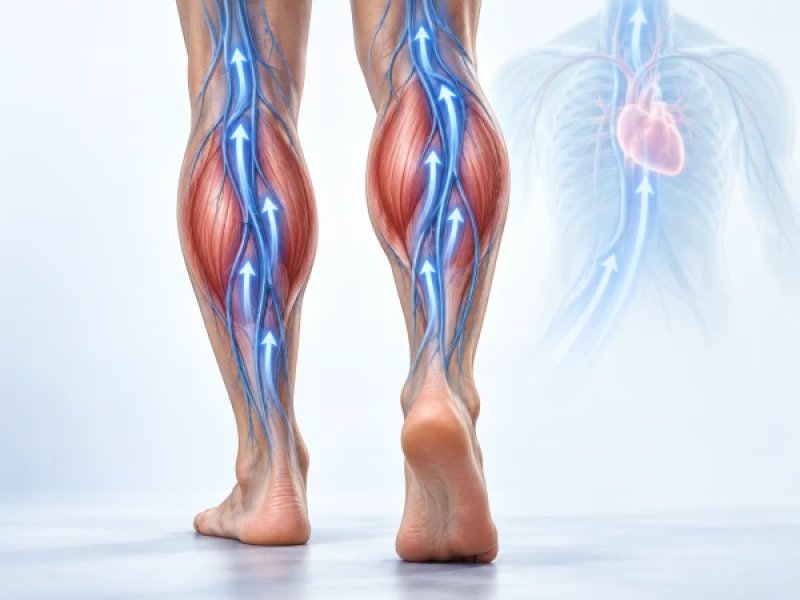
That is why the calf muscles are sometimes referred to as the 'second heart.' Their function is important not only for the feeling of lightness in the legs. Studies show that the efficiency of the so-called calf pump may also be linked to overall health. ## How the 'Second Heart' Works Blood moves through the arteries from the heart under relatively high pressure. However, returning from the legs back to the heart is more difficult; the pressure in the veins is much lower, and it also has to overcome gravity. This is where the calf muscles come into play. When walking, rising on tiptoes, or flexing the foot, the calf muscles contract and compress the nearby veins. As a result, blood moves upward. Venous valves prevent backflow. They close after each muscle contraction and prevent blood from descending back to the feet. Thus, every movement of the legs helps the venous system return blood to the heart. ## What Happens If This Mechanism Works Poorly The first signs of impaired venous outflow are familiar to many: heaviness in the legs, swelling around the ankles, and discomfort after prolonged sitting or standing. Over time, more serious problems can develop, including varicose disease. However, researchers have also noted another pattern. Mayo Clinic specialists analyzed data from nearly 3,000 patients and found that over ten years, about 18% of people with weakened calf pump function died, while among patients with normal indicators, the figure was about 6%. A later analysis of nearly 6,000 people confirmed the connection: the worse the calf muscles helped pump blood, the higher the risk of death. It is important to understand that such studies show **a correlation but do not prove causation**. Weak calf pump function may not be the cause of declining health but an indicator of other issues—sedentary lifestyle, age-related muscle loss, joint or nervous system diseases, as well as overall decline in physical fitness. ## How to Maintain Calf Muscles It is not necessary to buy a special machine or go to the gym every day. The simplest exercise is regular walking. Every step causes the calf muscles to contract and helps venous blood move upward. Other effective activities include: * climbing stairs; * running; * rising on tiptoes; * flexing and extending the feet. It is especially important to move for those who spend a lot of time at the computer. If you have to sit for long periods, it is advisable to stand up and walk a bit at least once an hour. When this is not possible, you can bend and straighten your feet several times right at your workstation or lift your heels while keeping your toes on the floor. For overall health, the World Health Organization recommends that adults engage in at least 150 minutes of moderate physical activity per week and perform strength exercises at least twice a week. ## When Leg Pain Should Not Be Dismissed as Fatigue Not every discomfort after a long day is harmless. If swelling, pain, redness, or a feeling of heat occur predominantly in one leg and do not go away, this requires attention. Such symptoms may occur with deep vein thrombosis. In this situation, it is necessary to seek medical help. ## A Special Muscle That Can Affect Metabolism Deep in the calf lies the soleus muscle. It is characterized by the ability to work for long periods without tiring as quickly as many other muscles. Researchers studied a specific movement sometimes referred to as the 'soleus raise.' A person sits, leaving the front part of the foot on the floor while repeatedly lifting and lowering the heel. In experimental conditions, such prolonged muscle work increased energy expenditure and improved the body's use of glucose and fats after meals. In a small study involving ten people with prediabetes, prolonged performance of this movement during a two-hour glucose tolerance test reduced the blood sugar peak by about one third compared to regular sitting. However, there is an important caveat: participants performed the exercise for a long time and almost continuously. Therefore, a few heel movements under the table are beneficial as additional activity but cannot replace full physical exercise or treatment prescribed by a doctor. ## Why It’s Important to Keep the 'Second Heart' in Shape Calf muscles indeed play a crucial role in venous circulation. They help blood return from the legs to the heart, thereby reducing the load on the venous system. You can support this mechanism in very simple ways—by walking more, using the stairs, regularly stretching your feet, and not spending many hours in a row without movement. Even a little activity throughout the day is more beneficial than prolonged sedentary sitting. Regular exercise helps maintain not only muscle strength but also normal circulation.
