

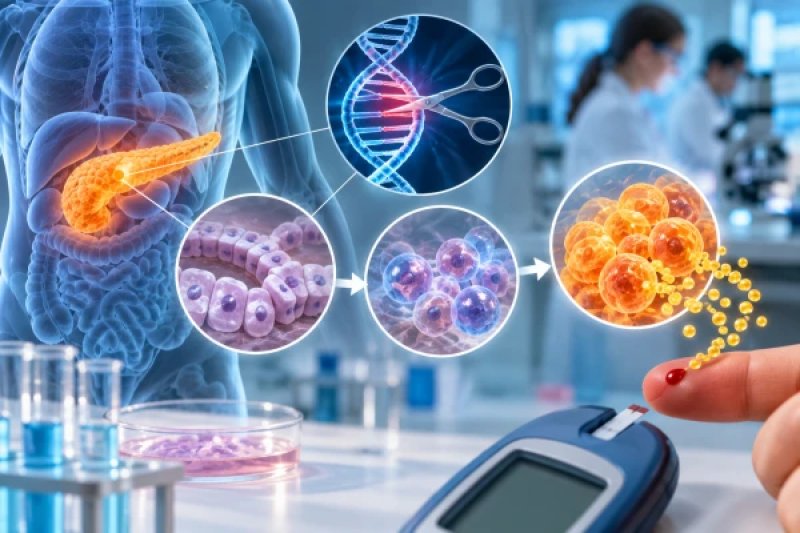
### A genetic 'brake' found The main role in insulin production belongs to the β-cells of the pancreas. In diabetes, their number or ability to function normally significantly decreases. One possible way to compensate for the loss is through the transplantation of donor cells or the use of cells derived from stem cells. However, such technologies face serious limitations, including a shortage of donor material and the risk of immune rejection. The authors of the new study decided to test another option: whether it is possible to reprogram the pancreas duct cells and make them perform the functions of β-cells. The results of the work were published in the scientific journal Science Translational Medicine. ### More than 19,000 genes tested To search for the mechanism that prevents the transformation of cells, the scientists used CRISPR technology and sequentially tested more than 19,000 genes. One of the key targets turned out to be the ALDH3B2 gene. It was found that it acts as a kind of 'brake' that prevents duct cells from changing their specialization. After disabling ALDH3B2, the cells began to lose the characteristic features of duct cells and simultaneously activated the genes necessary for insulin production and processing. The result was significant: under normal conditions, less than 1% of cells transformed into β-like cells, while after blocking ALDH3B2, their share reached 8.5%. ### Cells had to go through an intermediate stage The process of transformation turned out to be more complex than simply switching one function for another. Initially, the cells temporarily entered a state resembling immature pancreatic precursor cells. Then they gradually matured and acquired the properties of cells capable of producing insulin. Thus, the researchers managed to discover an intermediate stage that the cell goes through during reprogramming. ### Human cells tested on mice Next, the scientists checked whether the obtained human cells could work not only in the laboratory but also in a living organism. They were transplanted into diabetic mice. The cells engrafted, responded to changes in glucose levels, and released human insulin. After transplantation, the blood sugar levels of the animals decreased almost to normal values, and the effect persisted for six weeks of observation. This showed that the reprogrammed cells are capable of not only acquiring the external features of β-cells but also performing one of their main functions. ### Instead of gene editing — a pill? One of the most interesting results of the study is that it may be possible to influence the discovered mechanism without directly editing genes. A similar effect was achieved by the scientists using the substance DEAB, which affects enzymes of the same family to which ALDH3B2 belongs. The next task is to find more precise and safe molecules that can selectively block the necessary mechanism. If this is successful, and the effectiveness and safety of the approach are confirmed by further research, a drug could theoretically emerge in the future that stimulates the formation of the body’s own insulin-producing cells. ### There is still a long way to go before treating people Despite the impressive results, it is premature to talk about a new diabetes drug. The experiments were conducted with human cells in the laboratory, and their function was tested after transplantation into mice. Researchers still need to prove that a similar process can be safely initiated directly in the human pancreas. A separate problem is type 1 diabetes. The immune system of such patients attacks β-cells, so even if scientists learn to restore them, it will be necessary to figure out how to protect the new cells from being destroyed again. Nevertheless, the discovery of ALDH3B2 gives scientists a new potential target. In the long term, it may lead to therapy that not only provides the body with insulin from the outside but also helps it regain the ability to produce its own.
