

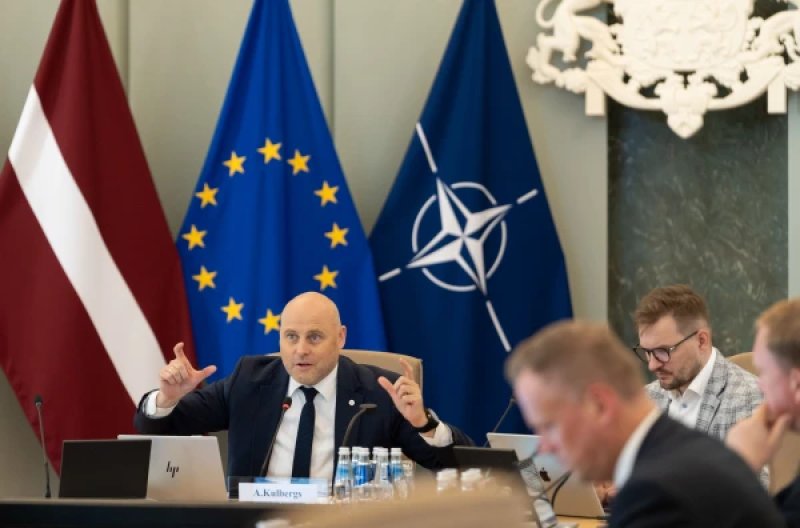
Thus, by the end of September, the government intends to approve a plan of measures to limit immigration, including legal immigration — in particular, the Minister of the Interior Janis Dombrava insists on the introduction of **quotas for the issuance of long-term visas and residence permits** to citizens of certain "at-risk" countries. It should be noted that the possibility of introducing such restrictions is also provided for in the newly enacted Immigration Law. By the end of September, the parliament may support in the final reading a package of bills within the framework of the so-called "reform" of **oversight of non-bank creditors** — we remind you that this concerns the transfer of supervisory functions from the Consumer Rights Protection Center to the Bank of Latvia. It cannot be ruled out that the parliament will urgently adopt a bill banning **the transit of grain and other agricultural products from Russia and Belarus**. As is known, the import of these products from the mentioned countries was banned last year. However, at that time, it was decided not to touch transit, since transit issues through EU countries fall under the competence of Brussels, not each EU country individually. But in the context of pre-election fever, anything can be expected… Especially since the majority of ruling parties have expressed support for the transit ban, and this issue was being discussed at the coalition council at the moment when this article was already being prepared for publication. The government is expected to give the green light today to the welfare ministry's plan for the gradual **introduction of basic pensions**. No, for now, the authorities do not intend to "tie" the minimum pension to the subsistence minimum or, even more so, to the minimum wage. The essence of the basic pension is that elderly people will finally be able to receive at least an additional payment for each year of service. So what does the welfare ministry propose? Starting from January 1, 2027, to pay pensioners aged 85 and older an additional payment for service up to 1996, taking into account indexing (3.25 euros for each year of service up to and including 1996) and for 1997 and all subsequent years, if the pensioner continued to work, 2.34 euros. An additional 13.4 million euros will be required from the budget next year for this. And then, each year, expand the category of pensioners who will receive such additional payments for service. They decided to start with pensioners aged 85 and older because they have the smallest pension — the average pension without an additional payment for service is 503 euros, with an additional payment — 586 euros. For comparison: the overall average pension in Latvia is 640 euros without an additional payment for service, and 679.21 euros with an additional payment. It is important to emphasize here: we are talking specifically about the average pension. There are those who receive pensions over 1000 euros, but there are also elderly people who try to survive on 400 euros. The government may manage to at least start the reorganization of the **notorious Society Integration Fund** before the elections. No, the authorities have changed their minds about liquidating it — it will be transformed into a kind of agency for managing integration (cohesion) projects. However, all decisions regarding the implementation of various projects will be made by the Ministry of Culture. However, this model proposed by the Ministry of Culture still needs to be approved by the coalition forces. To have something to present to voters, Prime Minister Kulbergs will surely achieve **the return of clerks from remote work** to their jobs in the relevant ministries and state agencies. The State Chancellery is preparing an analysis of the situation with remote work in public administration at the Prime Minister's request. ## The budget will not be touched Let us emphasize: from this government and this Saeima, no decisions related to the budget should be expected before the elections. The maximum that the government, or more precisely the Ministry of Finance, can do is prepare the general framework for the budget-2027 and for the next four years. But fundamental decisions regarding the budget will be made by the new government and parliament after the elections! It should be noted that after the elections, that is, after October 3, the Kulbergs government will not resign — it will continue to work until the new Saeima approves the next government.
