

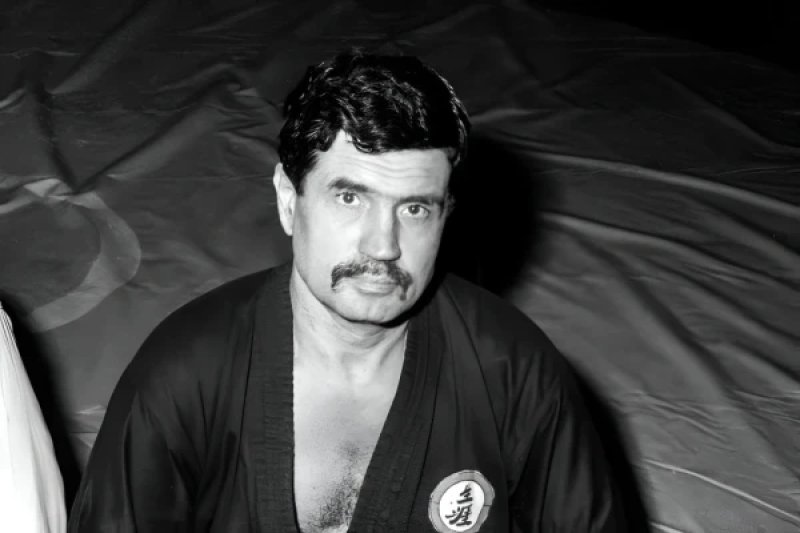
The action movie, in which everyone fights with everyone all the time, also served as a reason for the explosive growth in the popularity of martial arts in the USSR. It was these martial arts that Kasyanov primarily engaged in. He was born in Moscow in 1939. It is said that he grew up as an intelligent and not particularly athletic boy - such a child had a hard time in the yards filled with delinquents. He wanted to learn to defend himself and his loved ones. So, in 1953, the teenager joined a boxing section - and quickly achieved great success: by the age of 19, he took second place in the Moscow championship. Then he served in the army. After that, he worked as a taxi driver and felt that he had somewhat outgrown boxing - he wanted to find himself in something else. And at the age of 30, he accidentally gave a ride to a passenger who was interested in karate. That passenger was Alexey Shturnin - in the future a legend, one of the most famous Soviet and Russian karatekas. The passenger and the driver started talking, and Kasyanov tried to prove to Shturnin that karate was some kind of trendy nonsense... In the end, they met a few days later, decided to spar - and Kasyanov was very impressed by the effectiveness of his partner's strikes and defenses. He became his student. Then more and more students appeared. Shturnin also introduced Kasyanov to the legendary Anatoly Kharlampiev, one of the creators of sambo wrestling. Who, according to Tadeusz Rafailovich, "gave us the technique of combat sambo 'from' and 'to'." He also infected Kasyanov with a passion for knife throwing. In 1977, he made his film debut in the movie "In the Zone of Special Attention" about paratroopers (Kasyanov doubled for the main actor Mihai Volontir in fight scenes). Then there were "Pirates of the 20th Century," where Tadeusz Rafailovich acted as the "stunt director and a bit of an actor." Then more films like "Takeoff," "Black Triangle," "Alarm," "Action"... As mentioned earlier, karate was immensely popular in the late 70s: Kasyanov recalled that when the Central Karate School was established, 10,000 people came to enroll. But soon Kasyanov and Shturnin fell out, and then the latter ended up behind bars - Japanese wrestling became illegal in the USSR in 1984 and remained so until the late 80s. During those years, Kasyanov engaged in hand-to-hand combat, which he called "a new national sport" and taught future special forces from "Alpha" and "Vympel." In 1989, he became the president of the All-Union Federation of Hand-to-Hand Combat and Traditional Karate. He lived a very long life, training dozens of masters of sports. He loved cold weapons, but not firearms; he could not stand hunting - he considered it a crime to take a life from an animal without the utmost necessity. (It was written about him that even the trees for throwing knives were chosen exclusively dead and dried by his students). He also hated mixed martial arts: he said in interviews that "this is a deeply criminal activity. (...) There is no ideology in mixed martial arts - that is why they are criminal, any duel ends with injuries on one or both sides, it is not a sport, but a spectacle catering to the crowd, instilling the basest qualities in it." Tadeusz Kasyanov was buried at the Shcherbinskoye cemetery in Moscow.
