

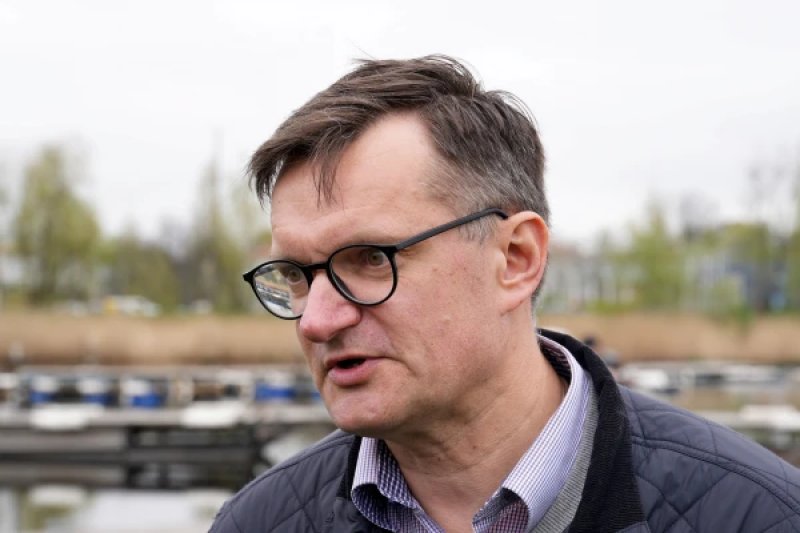
Former Secretary of State for Defense Janis Garisons made a brief political-military analysis on our continent on the social network Facebook and commented on possible plans of Russia. "I don’t think Putin can now start a conventional war with Europe, even if Europe is left without the U.S. This would mean that the existing front line would at least double and extend another 2000 km. Therefore, it would be more advantageous for Putin to test the boundaries and use various options for sabotage, covert operations, and diversions. In my opinion, the simplest but most effective way for Russia would be to send supposedly Ukrainian drones towards NATO to strike critical infrastructure targets. Looking at how NATO's sudden exercises to block Kaliningrad went a couple of weeks ago, and then Germany's reaction to the discovered explosive devices at the airfield in Leipzig, I would suggest that Russia was planning a serious operation/provocation specifically against Germany, which has never reacted before and preferred to downplay Russian provocations. This time, it seems, it was something very serious, as NATO decided for the first time to organize offensive, unplanned exercises against Kaliningrad. Unfortunately, Europe remains an easy target. Although there are many positive developments in the military capabilities of European countries, there is still a feeling that there is no rush. Worse still, it is evident that European politicians do not quite know how to handle the newly acquired tool of power — military force, as it has been considered a relic of the past that civilized people do not use. An additional European problem is that not only security issues are beginning to escalate, but economic ones as well. Technological superiority has been lost, competitiveness is declining, yet the European Commission continues to live in the past and thus increases bureaucracy, and America sees Europe more as a competitor in the economic sphere. The result will be that it will be increasingly difficult to maintain the standard of living of the population, and therefore the rise of right-wing forces to power is quite inevitable in the next elections (and here the problem is not that these forces are right-wing, but that, unfortunately, they are somehow under Putin's influence). And finally, we, as Europe, do not have a clear strategy on what to do with Russia and what our goal is. We want to sit at the negotiating table, but we are not exactly sure what we will do there. Although Europe has so many leverage points to pressure Russia and put an end to the war. But this is impossible, as there is not a single Margaret Thatcher or Winston Churchill in Europe right now. Therefore, we are preparing for very significant turbulence. Ukraine's success would allow Europe to return as a global player with minimal resources; the main thing is to become a decisive part of the new world order, but for this, we need to act actively ourselves, rather than relying solely on Ukrainians or Americans," Garisons noted in particular.
