

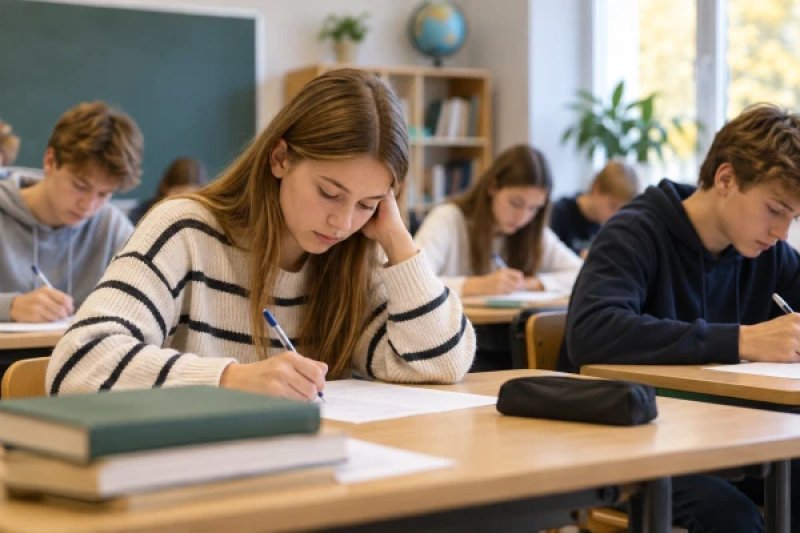
On Tuesday, September 8, the Cabinet of Ministers approved the amendments to the standards of primary and secondary education proposed by the Ministry of Education and Science. ### How many grades can be corrected Each school will still establish its own internal assessment procedures. For students in grades 1–3, the school must provide the opportunity to improve the summative grades received over the year in academic subjects. Students in grades 4–12 will be able to improve **at least one, but no more than one-third of the summative grades in each subject** during the academic year. Each specific grade can only be corrected once. The Minister of Education and Science called the government's decision an important step towards a more understanding school. According to her, it is necessary to ensure that a mistake in the learning process is perceived not as a punishment, but as an opportunity to improve one's knowledge. ### Ninth graders will face a new exam Starting from the 2026/2027 academic year, a centralized exam in natural sciences will be introduced for 9th graders. At the first stage, it will effectively serve as a tool for assessing the level of knowledge: there will be no minimum percentage threshold applied to the results of this exam. Therefore, its result should not become an obstacle to graduating from primary school. The exam will allow for the assessment of the actual level of students' knowledge in natural sciences and determine what changes are necessary in the educational process. ### High school students are given the right to choose Changes are also expected for high school students. The requirement to take at least one higher-level exam is being abolished. Now, students will be able to decide for themselves whether they need such an exam — for example, for further admission and education. ### Teachers must be prepared The State Education Development Agency (VIAA) has been tasked with organizing professional development for teachers in connection with the introduction of the natural sciences exam. By September 30, 2026, the agency must also assess how well schools are equipped with the necessary educational materials for natural science subjects. By October 30, schools and teachers must be provided with the program for the new exam, examples of tasks, explanations of the conditions for its implementation, and necessary consultations. Thus, starting in the 2026/2027 academic year, the assessment system in Latvian schools will become noticeably more flexible: students will have more opportunities to correct their results, but the number of such attempts will remain limited.
