

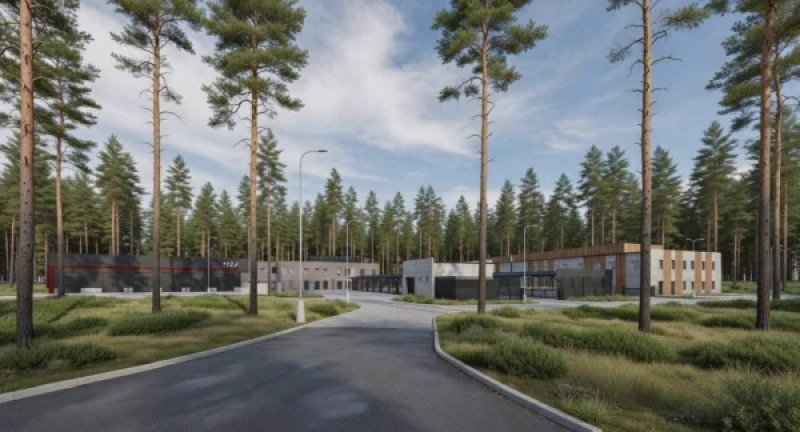
The project to create a network of Disaster Management Centers, considered one of the key initiatives to enhance Latvia's readiness for emergencies, has encountered a new wave of questions. The reasons are the construction costs of individual facilities and the specifics of conducting public procurement. The Disaster Management Centers are intended to bring together under one roof the State Fire and Rescue Service, the State Police, the Emergency Medical Service, and other operational services. A total of 32 such centers are planned to be built across the country, with nearly half already completed. The construction costs of individual facilities range from 2,500 to 3,600 euros per square meter. These figures are currently being analyzed by the Ministry of the Interior and the Prosecutor General's Office, according to Diena. Funding for the projects comes from several sources: the state budget, the Recovery and Resilience Mechanism, the European Regional Development Fund, and programs aimed at strengthening national security. Funding has not yet been found for three centers — in Jelgava, Jekabpils, and Valmiera. According to the advisor to the Minister of the Interior, Janis Ratkevich, procurements are conducted based on the principle of "design and build." However, problems have arisen at this stage. In several cases, the cheapest bids were excluded from the competitions. The reasons were not related to cost or the qualifications of construction companies, but rather formal errors in the documentation — for example, inaccuracies in filling out BIM/BIP forms or calculating turnover. In the competition for the construction of the center in Kuldiga, three bids with the lowest costs were rejected out of five participants. In Tukums, Talsi, and Aluksne, the situation was even more unusual: the only candidates were excluded, the procurements were canceled, and a year later, they were announced again — at a higher price. Project authors note that the cost per square meter depends not only on the building itself. A significant portion of the expenses is related to the preparation of the specific site, as well as specialized equipment needed, for example, for the State Fire and Rescue Service units. However, some expenses raised additional questions. In particular, in Kuldiga, the landscaping of a small flower bed cost about 3,500 euros, of which over 1,000 euros was the cost of the plants themselves. Another example concerns the construction of the DMC in Madona. Due to the specifics of the chosen site, more than 13,500 cubic meters of soil had to be brought in to level the area relative to the street located above. This work cost 212,689 euros. Such examples have drawn attention not only to the construction costs but also to the selection of individual design solutions at the preparation stage of the facilities. Currently, this is not about the conclusions of the inspections, but about the questions that have arisen among the responsible agencies. The assessment of the efficiency of expenditures and compliance with procedures will continue as the project for the construction of the network of Disaster Management Centers is implemented.
