

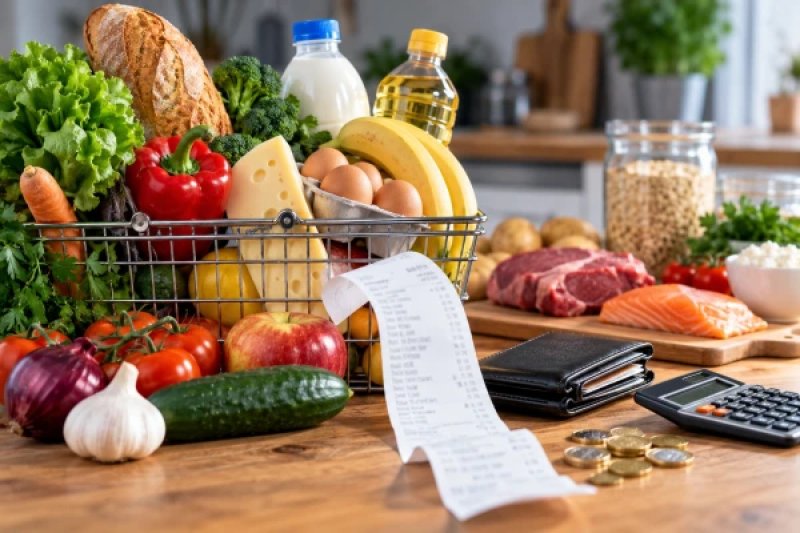
Over the past six years, household spending on food has increased by **53.5%**, with the growth in expenses being 3.8 percentage points lower than the overall increase in food prices. In 2025, households spent the largest portion of their food expenses on meat and meat products — 17%, milk, dairy products, and eggs — 17%, as well as grains and grain products — 12.3%. Households of elderly residents allocated the largest share of their daily expenses to food and non-alcoholic beverages, while households with children allocated the smallest share. Last year, households with at least one single person aged 65 and older spent **30.4% of their daily expenses** on food and non-alcoholic beverages. In households of elderly people where all residents were aged 65 or older, this share was **30.1%**. In comparison, families consisting of couples with children spent a smaller share of their total consumer budget on food and non-alcoholic beverages — **20.8%**, single adult households with children — **22.1%**, and other households with children — **23.2%**. The largest portion of monthly food expenses for Latvian households was directed towards meat and meat products, as well as milk and dairy products. Last year, meat and meat products accounted for 17% of food expenses, or **25.72 euros per month per person**. Households spent almost the same amount on milk, dairy products, and eggs — also 17%, or **25.66 euros per month**. A significant portion of expenses was also allocated to grains and grain products — **12.3%, or 18.51 euros per month**, as well as to vegetables, salads, and legumes — **11.7%, or 17.72 euros per month**. ### What is Consumed More in Rural Areas Rural households consumed significantly more of certain products than urban households. In rural areas, the average annual consumption per household member was **205 eggs**, while in cities it was 186. Residents of rural areas consumed **48.1 kilograms** of potatoes, while urban residents consumed 33.1 kilograms; milk — 38.2 and 34.8 liters; fresh pork — 18.4 and 11.1 kilograms; bread — 30.4 and 25.1 kilograms; canned vegetables — 12.1 and 8.9 kilograms; cucumbers — 11.2 and 9.1 kilograms; carrots — 9.2 and 6.7 kilograms. Additionally, rural households consumed more sugar — **11.3 kilograms per person per year compared to 7.9 kilograms in cities**. ### What City Residents Prefer Urban households, in turn, consumed more various food products purchased in stores and other retail outlets. For instance, cheese consumption in cities was **14.8 kilograms per person per year**, while in rural areas it was 12.3 kilograms; kefir and yogurt — 26.3 and 25.4 liters, respectively; poultry meat — 11.2 and 9.4 kilograms; ready-made meals — 17.2 and 14.2 kilograms. City residents consumed 11.9 kilograms of citrus fruits per person per year compared to 8.3 kilograms in rural areas, apples — 11.7 versus 10 kilograms, bananas — 11 versus 7.5 kilograms, and coffee — 2.9 versus 2.6 kilograms. ### Consumption of Potatoes, Bread, and Milk Has Decreased Over the past six years, the consumption of a number of traditional products has decreased. Per person in a household, egg consumption decreased from **210 pieces in 2019 to 192 in 2025**. Potato consumption fell from **47.9 to 37.4 kilograms**, milk — from 40.7 to 35.7 liters, bread — from 31.7 to 26.6 kilograms, fresh pork — from 16.4 to 13.2 kilograms, and fish — both fresh and smoked — from 10.3 to 7.6 kilograms. ### While Water, Yogurt, and Ice Cream Consumption Has Increased At the same time, households have started consuming more water. In 2019, the average annual consumption per person was 36.5 liters, while in 2025 it reached **57.7 liters**. Consumption of non-alcoholic beverages increased from 15.2 liters in 2019 to 23.8 liters in 2025, yogurt and kefir — from 18.2 to 26 liters, ice cream — from 3.7 to 5.8 liters, and cheese — from 13 to 14.1 kilograms. ### Almost Four-Fifths of Expenses Are on Food Purchases Last year, nearly four-fifths of all food expenses were spent by households on purchasing food in stores, markets, and other retail outlets. These expenses amounted to **142 euros per month per person**. Public catering accounted for an additional **30 euros per month**. Another **8.5 euros** were expenses on food in kind. This refers to the monetary value of food obtained through home cultivation, berry picking, fishing, hunting, or received for free from relatives, friends, or others.
