

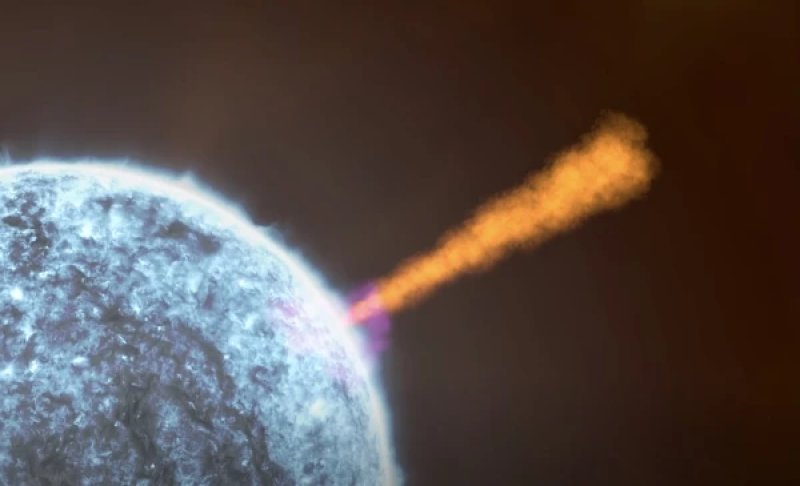
The gamma-ray burst GRB 221009A, dubbed BOAT (Brightest Of All Time), was detected on October 9, 2022. Among the particles it emitted, scientists discovered the highest-energy photon ever recorded from gamma-ray bursts, writes [Space](https://www.space.com/science/astrophysics/a-photon-from-the-biggest-cosmic-explosion-since-the-big-bang-appears-to-have-defied-einstein-scientists-may-finally-know-how). According to current physics understanding, such a photon should not have reached Earth. Over two billion light-years, it would inevitably have collided with photons from the cosmic microwave background — the relic radiation left over from the Big Bang — and lost its energy. However, this did not happen. "We started with a very simple question: how did this photon survive a journey that, according to known laws of physics, should have destroyed it?" said study leader Giorgio Galanti from the Italian National Institute for Astrophysics. To explain this phenomenon, the scientists proposed an unusual model. According to it, photons can temporarily transform into hypothetical axion-like particles and then revert back to photons. At the same time, the researchers suggest that at extremely high energies, one of the fundamental principles of Einstein's special theory of relativity — Lorentz invariance — may be violated. In that case, the photon could have avoided interaction with the relic radiation and traversed the cosmic distance almost unimpeded. Interestingly, the model also predicted that the record-energy photon should arrive about an hour later than the low-energy photons from the same gamma-ray burst. This delay was indeed observed. "If future observations confirm this scenario, the universe will become a natural laboratory for studying quantum gravity at energies far exceeding the capabilities of any terrestrial accelerators," noted study co-author Marco Roncadelli. So far, the new hypothesis remains just one of the possible interpretations of this unusual observation.
