

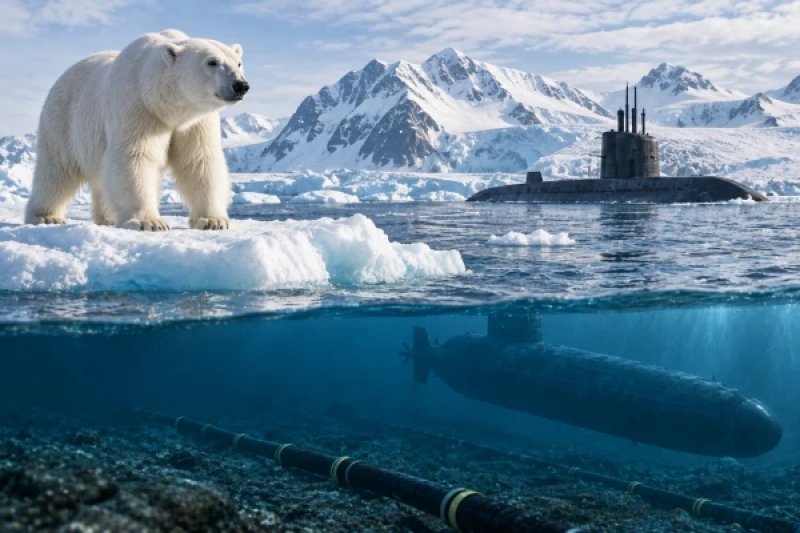
Underwater cables connect Svalbard and the mainland of Norway. Photo: Jonathan Nackstrand/AFP According to Reuters, in the spring of 2026, NATO allies prevented a sabotage operation being prepared by Russia against underwater cables in deep-water areas of the Arctic. Russian submarines were detected near the Svalbard archipelago, practicing the use of secret weapons designed to incapacitate critical underwater cables without leaving any traces, the agency reported on Thursday, September 10, citing two representatives of Western governments. ## Russians Were Forced to Leave the Exercise Area During a joint operation by the UK, Norway, and the US, Russian vessels were tracked and intercepted at sea. They were not allowed to complete their exercises and left the area, it was noted further. According to Reuters' sources, the secret operation was conducted by the forces of the Main Directorate of Deep-Sea Research (GUGI) of the Russian Ministry of Defense. Deep-sea vehicles were used to simulate the deployment of a complex and destructive system. The cables were not damaged; it was only about exercises. The authorities of the UK and Norway presented Moscow with the information they had to demonstrate their awareness of the new technology and to compel Russia to refrain from its use, Reuters reported, citing two Western officials. Norwegian Defense Minister Tore Sannvik believes that thanks to the joint operation, NATO allies "gave Russia a clear signal that it cannot act covertly." "We made it unequivocally clear to the Russian authorities that any attempt to encroach on our critical infrastructure will be detected and will have consequences. Escalation of tensions in the Far North is not in anyone's interests," Reuters quotes his statement. ## In April, London and Oslo Reported on Russia's Secret Operation in the Arctic In April 2026, the authorities of the UK and Norway had already reported the detection of a secret Russian operation in the Arctic, but information about the discovery of new weapons, the location of the operation, and the involvement of the US was not disclosed, the agency further writes. Meanwhile, US intelligence analysts are increasingly concerned that Russia may attempt to test the NATO collective defense pact, known as Article 5 of the North Atlantic Treaty, Reuters points out, citing three American officials. Russia may attempt to destroy critical underwater cables. In such a scenario, a key part of the Russian operation could be the destruction of underwater cables, which often have the thickness of a garden hose and run directly along the seabed or at a shallow depth in the ground, it is noted further. At the same time, they play a critically important role in ensuring global internet connectivity and conducting financial transactions. Due to their economic and strategic significance, underwater communications have already become targets in conflicts. Even during World War I and World War II, they were essential for transmitting orders via telegraph or telephone, Reuters reminds. From Svalbard to the mainland of Norway, two underwater fiber optic cables run at depths of up to 2700 m, stretching 1400 km. They transmit vast amounts of satellite data received by the world's largest ground station, SvalSat, which is part of NASA's Near Space Network. Reuters also recalls the visit to Moscow by the Director of the Central Intelligence Agency (CIA) of the United States, John Ratcliffe. According to information obtained by the agency from two informed sources, he warned representatives of Russian intelligence services against escalating sabotage actions by Russia in Europe during the meeting. However, Reuters could not determine whether Ratcliffe raised the issue of Russia's secret underwater operations.
