

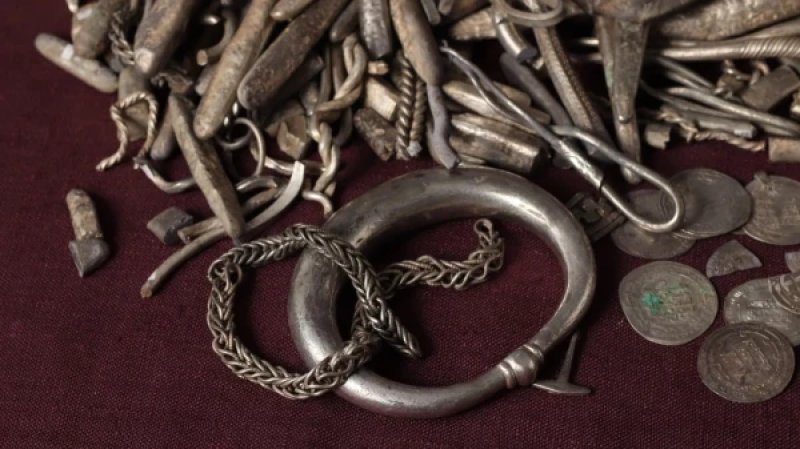
The discovery was made in the town of Rebild, south of Aalborg. The homeowner, wishing to remain anonymous, was clearing the area of grass, stones, and gravel when he stumbled upon unusual metal objects, [reports](https://nos.nl/artikel/2630439-deen-vindt-in-achtertuin-bij-toeval-grootste-vikingschat-ooit) NOS. At first, the man thought he had found old iron, wire from a fence, and shards. But as he continued to dig with his hands, he began to pull metal objects out of the ground one after another. It soon became clear that he was not dealing with household waste, but ancient jewelry, coins, and silver ingots. In total, the man discovered about **700 items and fragments weighing a total of 18.5 kilograms**. About 320 items weighing 6.4 kilograms were still inside a ceramic vessel, where they had been hidden approximately a thousand years ago. The remaining items were scattered in the ground around him. ## "It’s like finding a Viking bank safe" Among the hoard, archaeologists found a large number of silver ingots, bracelets, **47 whole coins, and numerous coin fragments**. Particularly significant were the Arab dirhams and Anglo-Saxon pennies from the time of King Edward the Elder, who ruled from 899 to 924. Thanks to the coins, specialists were able to more accurately determine the age of the find.  _Photo: Nordjyske Museer_ Among the items was also a small pendant in the shape of **Thor’s hammer**. Additionally, archaeologists found what is known as hacked silver — jewelry and other silver items that were intentionally cut or chopped into pieces. During the Viking Age, such silver was used as a means of payment: its value was primarily determined by its weight. Archaeologist Torben Sarauw from Nordjyske Museer considers the find extremely important for studying the Viking era. "It’s like we found a bank safe from the Viking Age," he metaphorically described the hoard. According to the archaeologist, the find demonstrates the role silver played as both a symbol of wealth and a means of payment. The presence of both Arab and Anglo-Saxon coins in one hoard further illustrates how extensive the trade connections of the Scandinavians were a thousand years ago. ## Who hid 18 kilograms of silver? Answering the main question — who owned the vast fortune and why it was hidden — is still difficult for archaeologists. Since the hoard was discovered in a modern residential area, it is impossible to conduct large-scale excavations directly around the find site. Experts suggest that a settlement or an important trade route may have been nearby a thousand years ago. However, another explanation is also possible: the owner of the treasure may have deliberately chosen a remote location to hide his wealth. Interestingly, the surroundings of Rebild have already yielded impressive finds for archaeologists. In 1971, about four kilograms of Viking-era silver — the so-called Rebild hoard — was discovered here. And just two months ago, near the neighboring Rold, archaeologists found six whole gold bracelets from the Viking Age. This new find, however, surpassed the previous ones: 18.5 kilograms of silver makes it the largest known silver hoard from the Viking Age discovered in Denmark.
