

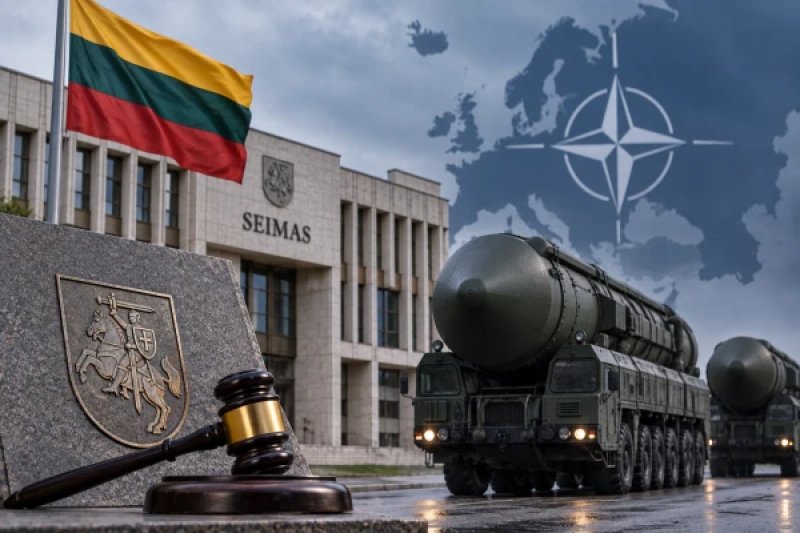
To do this, it will be necessary to extend the autumn session of the Seimas, which begins on Thursday, said the head of parliament, Jozas Olekas. "The schedules and deadlines for legislation we have set will likely require us to extend the autumn session a bit so that we can adopt this particular article of the Constitution," Olekas said at a meeting of the leaders of parliamentary factions. According to him, the autumn session will likely need to be extended until January 13, 2027. As previously reported by BNS, in early July, the Seimas approved an amendment to Article 137 of the Constitution, excluding the provision on the deployment of nuclear weapons in Lithuania. On Wednesday, the project received support from the Seimas Committee on Law and Order. Currently, Article 137 of the Constitution states that there can be no weapons of mass destruction or military bases of foreign states on the territory of Lithuania. Olekas had previously stated that this provision no longer corresponds to geopolitical reality. According to him, the state's priority in the current situation is to maintain peace, for which deterrence is important, with nuclear weapons providing the greatest effectiveness. According to the head of the Seimas, Lithuania with such a constitutional restriction "looks like a white crow in the context of NATO." To amend the country's fundamental law, at least 94 out of 141 parliamentarians must vote for it twice with a three-month interval. The initial initiative to amend the fundamental law was signed by about fifty parliamentarians from nearly all factions of the Seimas, with no support from any politician from the opposition party "Rising of Nyamunas." Discussions about the deployment of nuclear weapons are also stimulated by the idea presented in March by French President Emmanuel Macron to create a new European nuclear deterrence scheme, under which partners could temporarily host French strategic air forces with nuclear weapons. Meanwhile, in early June, the Financial Times reported that the U.S. is considering the possibility of deploying nuclear weapons in several additional NATO countries in Europe.
