

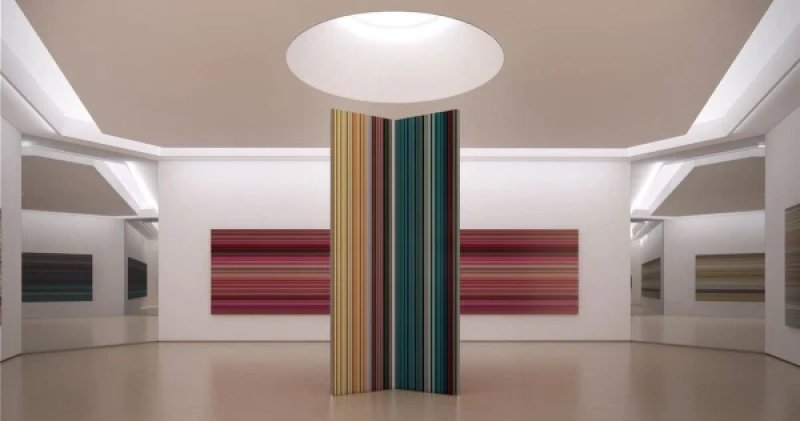
The pavilion will be located in MIA Park next to the Museum of Islamic Art in Doha. The project was developed by Richter himself in collaboration with the architectural firm Selldorf Architects, led by Annabelle Selldorf. The idea for a separate building came to the artist during a trip to Qatar in 2013. At that time, Richter was working on his famous "Strip" series and decided to create a space where architecture could extend his artistic experiments. The pavilion will take on a hexagonal shape. Its facade will be adorned with decorative panels featuring a pattern from the "Patterns" series (2011). This pattern emerged from the artist's digital experiments with a photograph of his own painting "Abstract Painting (724-4)" created in 1990. The main feature of the ornament will be 8,192 ultra-thin symmetrical stripes. Equally unusual will be the interior of the pavilion. Huge mirrored panels will be installed between three works from the "Strip" series. They will simultaneously reflect the paintings, the interior, and the visitors, allowing the audience to effectively become part of the artistic composition. In the center of the hall, another work by Richter will be placed — a three-part sculpture titled "Strip Tower," created specifically for the new pavilion. The opening is scheduled for November 20, 2026. This date was chosen deliberately: the very next day, Qatar will host its first-ever international contemporary art quadriennale, Rubaiya Qatar. Thus, Richter's pavilion will not only serve as an exhibition space but also as an independent work of art, where painting, architecture, mirrors, and viewers will be united in a single composition.
