

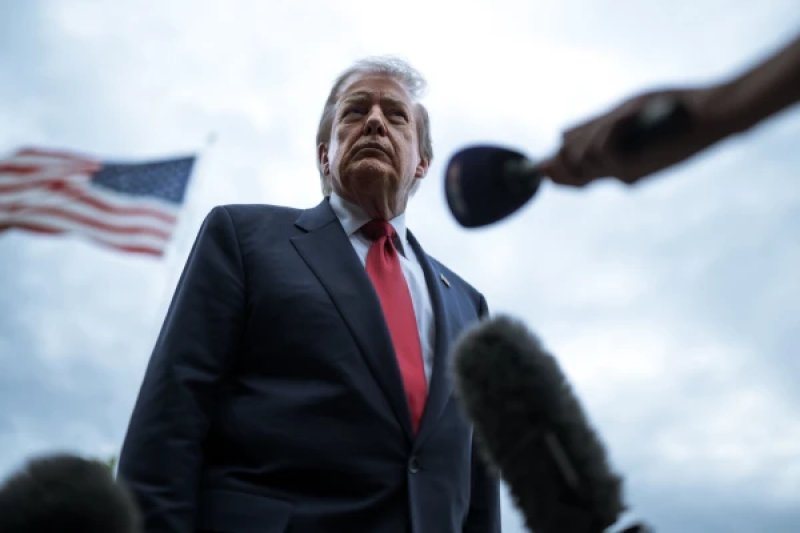
Trump spoke on one of the most sensitive topics in British and Irish politics after meeting with Irish Prime Minister Micheál Martin on Saturday, September 12. In response to a journalist's question about the unification of the island, the U.S. President first noted that he did not want to "create problems," and then said: "I would love to see it united." According to Trump, the unification of Ireland would be a "fantastic event." He also suggested that it is ultimately inevitable. "It’s going to happen someday. So why not now?" the president stated. At the same time, Trump acknowledged that the United Kingdom, "of course, will have something to say about it." Trump did not stop there. He called the Irish Prime Minister Micheál Martin, who was sitting next to him, "the right person to start this process." For the Irish Prime Minister himself, this became quite an awkward situation. "The Irish Times" points out that Martin has faced criticism from supporters of Irish unification - including some politicians from his own Fianna Fáil party - for being too cautious on this issue. The question concerns a border that has existed for over a hundred years. After the partition of the island in 1921, most of it subsequently became the independent Irish Republic, while six counties in the northeast remained part of the United Kingdom. For decades, the status of Northern Ireland has been a cause of severe confrontation between nationalists, who predominantly support the unification of the island, and unionists, who wish to keep the region within the United Kingdom. The Belfast Agreement, or Good Friday Agreement, of 1998 created the political foundation for ending this confrontation. One of its key principles is that the future of Northern Ireland is determined by the will of its people. Therefore, neither the U.S. President nor the Irish government can simply make a decision about the unification of the island. According to polls, a majority of residents in Northern Ireland still support keeping the region within the United Kingdom, reports Deutsche Welle. However, after the United Kingdom's exit from the European Union, this majority has shrunk. The Irish Republic remains a member of the EU.
