

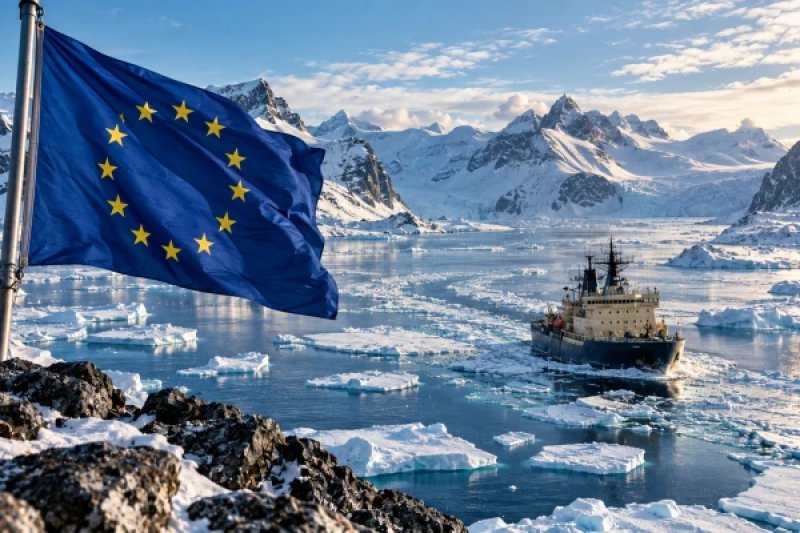
At the European Arctic Summit held on September 13–14 in Rovaniemi, Finland, representatives from 12 EU member states stated that the European Union must play a more "strategic and proactive" role in the Arctic. The joint statement was supported by **Finland, Denmark, Sweden, Germany, France, the Netherlands, Poland, Latvia, Lithuania, Estonia, Romania, and Greece**. The countries demanded sufficient resources to protect the interests of the EU and to take into account the radically changed geopolitical situation. ### Russia Identified as the Main Long-Term Threat One of the central themes of the meeting was security. Finnish Prime Minister Petteri Orpo, after the summit, named Russia as the main long-term threat to the stability and security of the Arctic. President of the European Council António Costa stated that what is happening in the Far North concerns the entire European Union, and that Arctic security is part of European security. German Chancellor Friedrich Merz also emphasized the need to strengthen the EU's presence, which should complement NATO's activities. According to him, it is in Northern Europe that new threats to European security are particularly evident. This is an important shift. The previous EU Arctic strategy, adopted in 2021, focused primarily on climate, ecology, and economic development. Now security and geopolitics are coming to the forefront. An updated EU Arctic strategy is expected this fall. ### Why Europe Needs the Arctic The reason is not only Russia. Due to the shrinking sea ice, new shipping routes and mineral deposits are gradually becoming more accessible. The region is significant in several areas: defense, maritime communications, critical raw materials, energy, underwater infrastructure, space technologies, and trade. At the same time, China's interest in Arctic routes and resources is growing. At the summit, Finland, in particular, promoted the idea of creating a more serious European icebreaker capacity. Germany supported this initiative. Finland has unique expertise in this area: according to Finnish sources, about 80% of the world's icebreakers are designed in the country, and about 60% are produced there. ### Why This Is Especially Important for Latvia and the Baltics The participation of Latvia, Lithuania, and Estonia in the joint statement is indicative. The Baltic countries effectively support an approach where the Baltic Sea, the North Atlantic, and the Arctic are viewed as elements of a unified northern security space for Europe. This has practical implications. After Finland and Sweden joined NATO, the northern flank of the alliance became geographically continuous—from the Baltic region to the Far North. As early as July, 12 NATO countries, including Finland, Sweden, Germany, France, and the Netherlands, agreed to enhance joint responsibility for maritime security in the **Baltic Sea, North Atlantic, and Arctic Ocean**. For Latvia, this means that the protection of the Baltic Sea is increasingly seen in connection with events in the Far North. Russian bases and the Northern Fleet, maritime communications in the North Atlantic, Arctic routes, and the protection of underwater infrastructure are becoming parts of a single strategic picture. ### The Arctic Becomes a New Geopolitical Frontier Not long ago, European policy in the Arctic was primarily focused on climate change and economic cooperation. Now the approach is changing significantly. Russia is strengthening the military component of its presence in the North, China is seeking access to new routes and resources, and Europe is trying to prevent a situation where decisions about the future of the Arctic are made without it. AP notes that melting ice simultaneously opens new maritime routes and facilitates access to mineral resources, intensifying international competition. The statement from 12 countries is not just a diplomatic declaration about the Arctic. It reflects a deeper shift in European policy: the Far North is beginning to be viewed as a full-fledged area of defense and strategic competition alongside the Baltic and Black Seas. For Latvia, this means an increased significance of the entire northeastern flank of NATO and the EU.
