

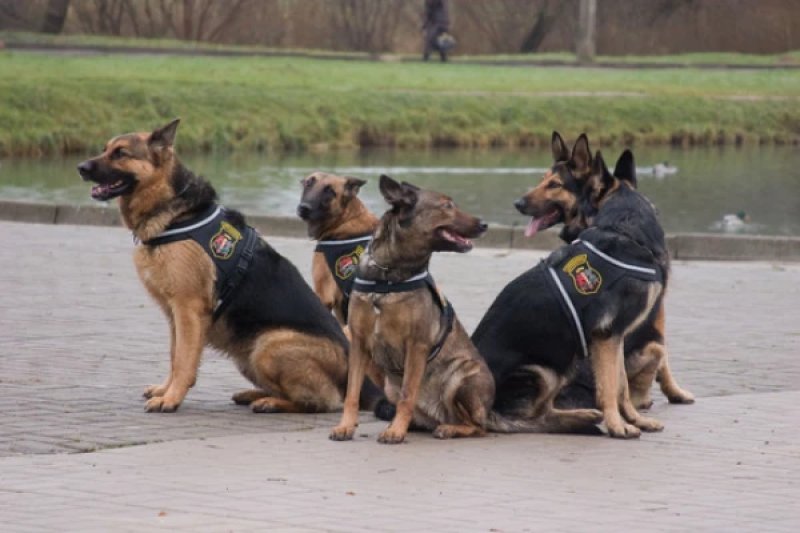
Less than 30 years ago, dog handlers in Rezekne lived in trailers and cooked porridge for service dogs themselves, recalls the head of the Canine Service Alexander Petrovsky. Now, at this site, a new center is being created for more than seven million euros, which, according to the Border Guard, will become one of the most modern in Europe. "Here, we could train dog handlers from all over Europe. Because at the moment we have competitive advantages. We have trained personnel. We have an external border where we can go out and show, for example, to everyone who does not have an external border. We have preserved forests where we can leave traces and, for example, compare with Portugal or Spain, where such conditions do not exist," says Petrovsky. In Rezekne, training and living facilities for dog handlers are being created, a place for 30 service dogs, two training fields, and a special laboratory. In it, regardless of weather conditions, it will be possible to simulate real inspections and train dogs to search for drugs and explosives, including in vehicles. "Without a service dog at the border, it is impossible. Because in any violation, border violation, a dog handler with a service dog is always involved. This is the search for traces, the search for violators," shares Petrovsky. Linda has been working at the Canine Center of the Border Guard College for five years. During her service at the border, she has repeatedly realized that it is the four-legged partners who are indispensable helpers. "In my case, it was like this: I was following a trail with my dog that she indicated, and I noticed that the dog stopped. Our dogs have an active indication when they find a person: the dog just starts barking. You approach and see only the legs of the violator. He has camouflaged himself, hidden so that he would not be found. A person would not notice. He would run past and go on," recounts Linda Bumbisha, an inspector at the Canine Center of the State Border Guard College. Currently, Linda's working partner is a three-year-old Henda. Henda not only searches for drugs but is also the mother of eight future service dogs. Together with Henda, Linda trains puppies and young dog handlers, and when necessary, they also assist the police and other services. "I can say that a dog with you is truly teamwork because often the human eye does not notice much of what the dog can smell. It eases your daily work and really creates a sense of security. (...) And in the current situation at the border, everything is really trampled down. There have been many different people crossing the border. They can only be qualitatively detected with the help of a dog. (...) The dog picks up the individual scent and immediately, without hesitation, follows that trail," notes Bumbisha. The new Canine Complex of the Border Guard is planned to be opened in June next year.
