

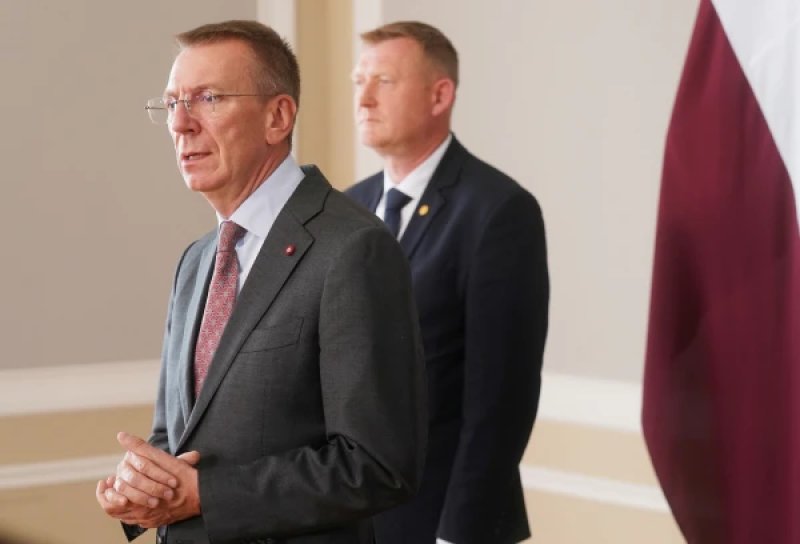
So, yesterday, as is known, the President of Latvia, while on a visit to the USA, disseminated a statement through social media in which he warned of possible attempts by Russia, according to Rinkēvičs, to "escalate acts of sabotage and diversions." And although the head of state in the same statement called for no panic, the alarm after these remarks by the president only intensified and a number of questions arose. One of them is: what does the president know that ordinary Latvians do not? Are we on the brink of war? It was even necessary, after this statement by Rinkēvičs, to hold a "public psychotherapy session" with the Prime Minister and the Minister of Defense, assuring that there is no danger of a conventional military attack, as evidenced by the absence of any concentration of Russian troops near the border with Latvia. So why did Edgars Rinkēvičs issue a special statement? Here are 4 main reasons. The first reason is that in a number of EU countries, primarily in Poland, information has emerged in recent weeks, citing intelligence services, that Moscow is planning certain diversions primarily against Poland and the Baltic states. The director of the Latvian Center for Geopolitical Studies, Māris Andžāns, even stated the possibility of an attack on the Baltic states using allegedly "lost" drones and even missiles. Hence Rinkēvičs's statement, which, judging by the reactions of other high-ranking officials, was coordinated with them. The second reason is the need to explain to the population the appearance of additional fighter jets from other NATO countries in Latvia. The third reason is a kind of signal to Russia, a preventive measure - saying, you there in Moscow, keep in mind that we know everything and are preparing, so it’s better not to. The fourth reason is the upcoming elections and the need to mobilize, conditionally, the national-patriotic electorate and passive citizens to increase voter turnout. After all, Rinkēvičs cares about what the balance of power in the new parliament will be, as in May next year, the Saeima will elect a president, and Rinkēvičs is interested in good results from those parties that could certainly support the re-election of the current head of state for a second term. The meaning is simple: you see, the enemy is already at the door, and in this very dangerous situation, it’s better to vote "for the lesser evil," for proven politicians.
