

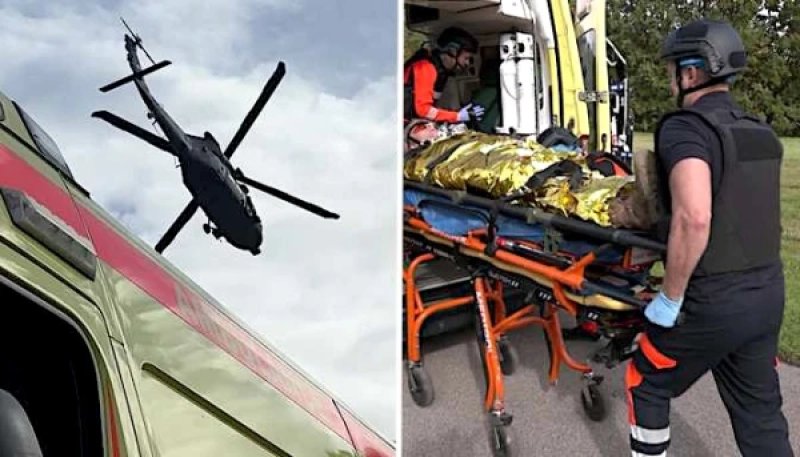
On Saturday, as part of the Namejs military exercises in Riga, a large-scale training on the evacuation of conditionally wounded soldiers took place. For the first time, the entire chain of medical assistance was fully practiced — from transporting the injured from the battlefield by helicopter to their handover to the doctors of the Stradins Clinical University Hospital. According to [TV3 News](https://tv3.lv/zinas/latvija/no-kaujas-lauka-lidz-operaciju-zalei-macibas-namejs-iesaistot-helikopteru-izspele-ievainoto-karaviru-evakuaciju/), a key element of the exercises was the Black Hawk helicopter of the Latvian Air Force, which landed in Victory Park. For many passersby, this was an unusual sight — the helicopter attracted more attention than the nearby European Family Festival. According to the scenario, the crew transported four conditionally wounded soldiers. Prior to this, military medics had already provided them with first aid and stabilized their condition; however, further treatment required transportation to a specialized hospital. Acting Chief Medical Officer of the medical company of the 1st Riga Brigade of the National Guard, Monta Ostrovska, explained that in such injuries, the speed of evacuation is crucial. > "The condition of the wounded required as quick a delivery as possible to a medical facility where they could receive higher-level assistance. That is why helicopter evacuation was used," she noted. After landing, every second counts. For safety reasons, the helicopter cannot remain on an open area for long, so the handover of the injured to the Emergency Medical Service teams is carried out as quickly as possible. The patients were then transported to Stradins Hospital, where the next stage was practiced — providing specialized medical assistance already in a civilian medical institution. According to the head of the hospital's security department, Matiss Šmitiņš, such exercises allow for checking not only the hospital's readiness but also the interaction of all services in crisis conditions. > "The most important thing is practicing cooperation between military and civilian structures, because in a crisis, they act as a single system," he emphasized. The hospital is ready to accept significantly more patients During the current exercises, only four conditionally injured individuals were transported to the hospital. However, the hospital notes that it is prepared to operate in much larger-scale incidents. For instance, during similar exercises last year, the medical facility received 103 conditionally injured individuals in less than three hours. According to hospital representatives, if the number of wounded exceeds 50–100 people, some planned medical assistance may be temporarily limited — similar to what happened at the beginning of the COVID-19 pandemic. Special action plans have already been developed for such scenarios. The Namejs exercises will last until October 8. In the coming weeks, residents of Latvia will be able to see more frequent movements of soldiers, national guards, military equipment, and allied units in various regions of the country. Such training allows for checking not only the readiness of the army and medics but also the ability of various services to act as a unified system in the event of a large-scale crisis.
