

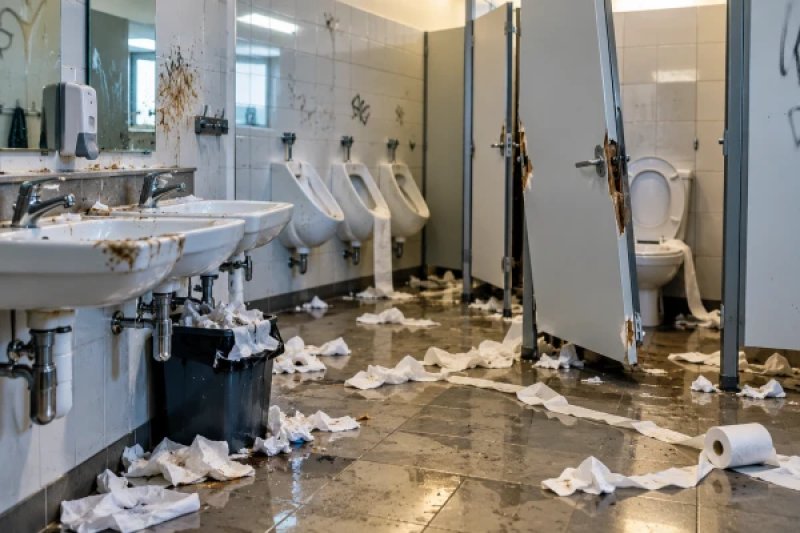
According to her, despite the school being new, one of the toilets has already been seriously damaged by students. The author claims that children are dirtying the floor and plumbing, climbing on the toilets with their feet, and regularly leaving a mess behind. She wonders how widespread such behavior is in other Latvian schools. In the comments, it became clear that similar situations have been encountered in other educational institutions. Some users recounted broken doors, damaged soap dispensers, scattered toilet paper, and deliberately soiled facilities. One former school employee recalled that due to such problems, teachers had to supervise near the toilets and mark students who visited them during lessons. Another woman shared an incident where students poured a bag of chips into a urinal, added lemonade, and included a roll of toilet paper. Discussion participants suggested various ways to combat vandalism. Among the ideas were organizing student duties, requiring the offenders to clean up the consequences of their actions, and making parents compensate for the damage caused. There were also suggestions to increase monitoring near the toilets. One commenter cited the Netherlands as an example, claiming that there, in similar cases, students could be kept at school until the offenders confess and clean up. However, this was described as the personal experience of the discussion participant, not as an official rule. Some users believe that responsibility lies not only with the children but also with their parents and upbringing. Others note that such behavior cannot be considered normal, and without specific accountability for damaging school property, it will be difficult to change the situation. Judging by the comments, the problem is not limited to one school; however, the stories shared in the discussion are personal testimonies from social media users and do not, in themselves, indicate how widespread such cases are throughout Latvia.
