

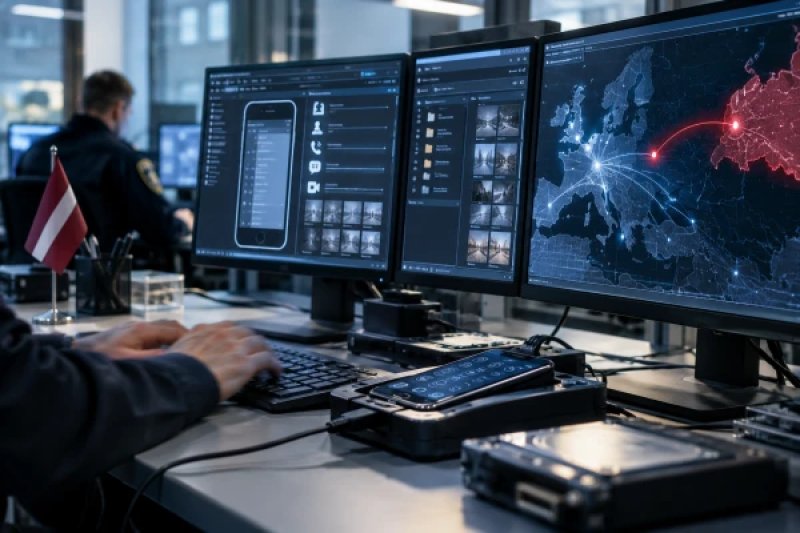
As [reported](https://www.politico.eu/article/russia-tech-surveillance-company-infiltrated-europes-law-enforcement-agencies/) by Politico, citing reviewed documents and open data, Oxygen Forensics develops powerful digital forensics tools that allow for the extraction and analysis of information from smartphones and computers. Its products have been used or purchased by law enforcement agencies in Germany, Spain, Italy, Poland, Hungary, Romania, and Latvia. Moreover, according to the publication, Romania and Latvia acquired this software quite recently—in September 2026. Last week, the U.S. Department of Justice officially accused Virginia-registered Oxygen Forensics of concealing that the company was actually owned by Russians and managed from Russia. ### Development Led from Russia According to materials from the U.S. Department of Justice, the software of Oxygen Forensics was developed and maintained by a team located in Russia under the leadership of Russian citizen Oleg Sergeyevich Davydov. Publicly, however, the company was allegedly led by 55-year-old American Lee Ryber from Boise, Idaho. Ryber was arrested in the U.S. Davydov was detained at London’s Heathrow Airport when he was about to fly to Istanbul. American investigators claim that after sanctions were imposed on Russia in 2022, the Russian owners of Oxygen concealed both their ownership and the fact that the software development continued in Russia. ### The Same Technology—Used by the FSB and the Ministry of Internal Affairs of Russia Another noteworthy circumstance is that five Russians behind Oxygen Forensics simultaneously controlled the Russian company MKO Systems. According to American investigations, this company sold software based on the same core technology to the FSB and the Ministry of Internal Affairs of Russia. It is important to emphasize that the U.S. Department of Justice does not claim that the programs of Oxygen contained malicious code or that the company gained unauthorized access to the systems or data of its clients. Nevertheless, American investigators confiscated the company’s bank accounts, 57 internet domains, and other digital infrastructure that, according to the prosecution, was used to commit the alleged violations. ### Oxygen Participated in EU-Funded Projects Politico also found that Oxygen Forensics products were used in at least two projects funded by the European Union. The first—EVIDENCE (European Informatics Data Exchange Framework for Courts and Evidence)—received over €1.9 million in European funding from 2014 to 2016. Oxygen Forensics was among the companies consulted on issues of processing and exchanging digital evidence. The project involved a wide network of European structures, including Europol, Eurojust, and the digital forensics unit of the European Anti-Fraud Office OLAF. The second project—INSPECTr, funded under Horizon 2020—was intended to help European police consolidate and analyze digital evidence obtained through various programs. The developed system could work with data extracted using Oxygen Forensics. The European Commission emphasizes that Oxygen itself was not part of the consortia for these projects and did not receive direct funding from the European Commission. ### The Program Also Reached Latvia The geography of the use of Oxygen technologies turned out to be significantly broader than just a few major EU countries. In Hungary, the police signed a contract with the company worth 10.14 million forints—about €27,000. In Italy, the Sassari Prosecutor's Office included Oxygen Forensics in April 2026 in the list of recognized systems that judicial police could use to extract and analyze information from mobile devices. In Spain, a national police specialist certified by Oxygen Forensics participated in training police specialists in digital analysis. According to Politico, law enforcement agencies in Romania and Latvia purchased Oxygen Forensics software back in September 2026. National law enforcement agencies that used the company’s products did not respond to the publication's inquiries. ### Experts Demand Investigation Natalia Krapiva, a senior legal advisor at the human rights organization Access Now, told Politico that public organizations have warned for many years about the Russian owners of Oxygen Forensics and the ties of the development to Russia. In her opinion, the use of such technologies when dealing with sensitive information by European law enforcement requires thorough investigation. However, there is currently no evidence that police data from EU countries or Latvia was actually transferred to Russian authorities or became accessible to them. Thus, the main question now is not about an established data leak, but about the potential risk: the software of a company with Russian owners was used by law enforcement agencies across Europe, including Latvia, while a Russian company linked to the same owners supplied technology to the FSB and the Ministry of Internal Affairs of Russia. Now European authorities need to determine whether such overlap could pose a threat to confidential police data.
