

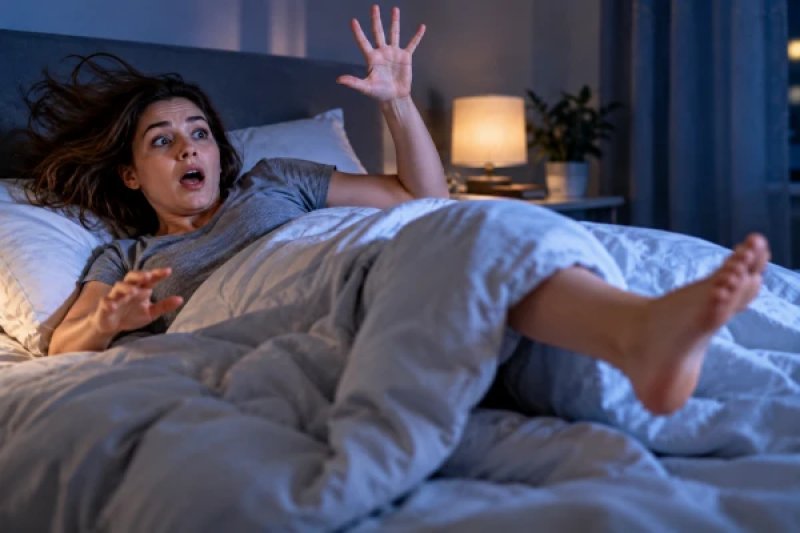
You are almost asleep, your body is relaxed — and suddenly your leg or your whole body jerks sharply, your heart starts racing, and sometimes there is a distinct sensation of falling. This happens to most people and even has a scientific name — **hypnic jerk**. As [Science Blog](https://scienceblog.com/d-science-has-a-name-for-the-jolt-that-can-snap-you-awake-just-as-you-fall-asleep-a-hypnic-jerk-and-one-leading-theory-is-that-the-brain-mistakes-relaxing-muscles-for-the-sensation-o/) writes, this phenomenon is also called "sleep start" or hypnagogic jerk. It refers to myoclonus — brief involuntary muscle contractions. Despite the sometimes frightening sensations, specialists consider such episodes to be generally normal and harmless. ### Most People Experience This According to the American Academy of Sleep Medicine (AASM), about **60–70% of people** experience hypnic jerks. The actual prevalence may seem lower simply because a person does not always remember what happened. Usually, it is one sharp muscle contraction, often of the arms or legs. Sometimes a person simultaneously feels as if they are falling or sees a brief fragment of a dream or experiences an unusual sensation. Occasionally, the jerk is accompanied by a scream. This phenomenon has been known in medicine for a long time. As early as 1959, researcher Ian Oswald dedicated a scientific paper to it with the telling title "Sudden Body Jerks Upon Falling Asleep." ### Why the Brain Thinks We Are Falling The exact cause of hypnic jerks has not yet been definitively established. However, there is an interesting theory. When a person falls asleep, the muscles gradually lose tone and the body relaxes. It is suggested that the nervous system may sometimes mistakenly perceive this sudden relaxation as **the sensation of falling**. As a result, the brain seems to activate an emergency alarm and sends an impulse to the muscles, causing the body to jerk sharply. Science Blog compares this mechanism to an overly sensitive fire alarm that goes off not due to a fire, but merely because of an open oven. But this is just one of the possible explanations. There is another hypothesis: the movement may be a reaction of the body to images or sensations that arise as one falls asleep. Researchers acknowledge that the physiology of hypnic jerks is not fully understood. ### An Inheritance from Ancestors Who Slept in Trees? There is also a more unusual evolutionary hypothesis. Psychologist Frederick Coolidge and anthropologist Thomas Wynn suggested that the hypnic jerk may be an ancient reflex inherited from ancestors who had to sleep in trees. According to this version, muscle relaxation could be perceived by the brain as the beginning of a fall from a branch. A sudden awakening would prompt the sleeper to change position, potentially saving them from falling. The authors cited data showing that primates can build nests in trees at heights of about 10–20 meters. However, this version is not proven and remains a hypothesis. ### Coffee, Stress, and Sleep Deprivation Can Intensify Jerks Certain circumstances can make nighttime jerks more frequent and intense. The American Academy of Sleep Medicine identifies factors such as high caffeine intake and other stimulants, intense physical activity, and emotional stress. The Sleep Foundation also mentions nicotine and lack of sleep. A sort of vicious circle may arise: strong jerks frighten a person, leading them to become anxious before sleep, making it harder to fall asleep. ### When to See a Doctor In most cases, hypnic jerks do not require treatment. It is not always possible to completely eliminate them, even with a good sleep schedule. Simple measures can reduce their frequency: decreasing caffeine and nicotine intake, scheduling intense workouts for earlier in the day, maintaining a regular sleep schedule, and reducing stress before bedtime. However, if the jerks become so frequent or intense that they interfere with sleep or cause fear of falling asleep, specialists recommend consulting a doctor. Regular involuntary muscle contractions occurring while awake require special attention. So the familiar feeling of "falling and waking up suddenly" in most cases does not indicate illness. Perhaps the brain simply momentarily mistakes normal relaxation before sleep for falling — although why this effect occurs remains to be fully understood by science.
