

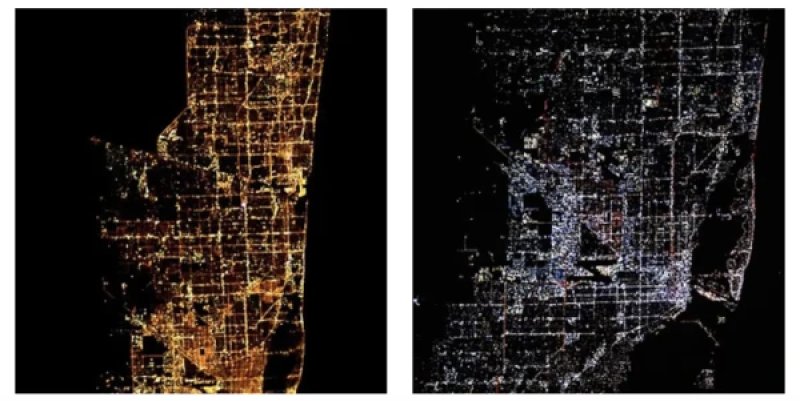
NASA astronaut Don Pettit, who has spent nearly 600 days in orbit over 23 years, published a series of images showing how the night appearance of Earth is changing. The photographs, taken during four expeditions to the International Space Station, demonstrate the global transition of cities from warm yellow-orange lighting to white LED lights. According to Pettit, traditional sodium lamps are gradually becoming a thing of the past, giving way to LEDs. The main reasons for this are reduced energy consumption and environmental requirements. "The warm yellow-orange light of gas-discharge lamps is gradually disappearing around the world, giving way to LEDs," the astronaut noted. Changes are particularly noticeable in Las Vegas and Miami. Comparing photographs taken approximately 12–13 years apart reveals how much the color of urban lighting has changed. Pettit stated that the yellow glow of sodium lamps used to obscure many details of the night city. After the widespread adoption of LEDs, colorful lights from streets, buildings, and advertising structures became distinguishable from orbit. Las Vegas, which the astronaut calls one of the brightest cities on the planet, has taken on an even more unusual appearance due to new LED features, including the spherical complex Sphere, which is easily visible from orbit as a bright purple spot. Similar changes have also occurred in Chicago, São Paulo, and Seoul. However, the transition to LEDs is not happening at the same pace everywhere. For example, in Mexico City, most street lighting has already been replaced, but dark areas remain in natural parks and reserves. An interesting contrast is also noticeable between Hong Kong and the nearby Chinese city of Shenzhen. While Hong Kong has largely retained its traditional night lighting, the neighboring megacity stands out with a large number of bright LED light sources. NASA studies show that changes have affected not only the color of lighting but also its intensity. In some countries, nights have, on the contrary, become darker. For instance, from 2014 to 2022, the level of night lighting in the UK decreased by about 22%, while in France, it dropped by nearly 33%. Despite the high energy efficiency of LEDs, scientists point out the so-called "rebound effect." As lighting became cheaper, cities began to install more fixtures. As a result, the energy savings from each individual lamp do not always lead to a reduction in overall electricity consumption and a decrease in light pollution. Researchers also note that modern white LEDs contain more blue spectrum. This type of light can affect the circadian rhythms of animals, their spatial orientation, and behavior at night. Even the use of warmer LEDs in some cities has not yet compensated for the mass transition to cold white lighting. According to scientists, photographs from the International Space Station allow for a better view of the scale of the ongoing changes: in just one decade, many cities around the world have completely transformed their night appearance.
