

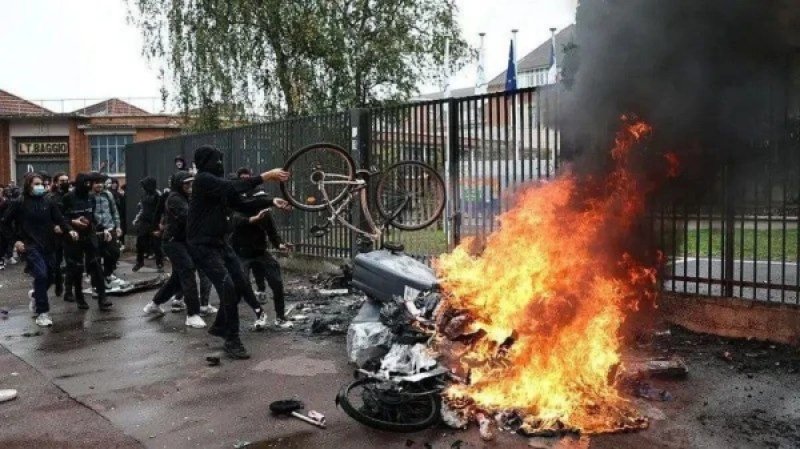
France has been engulfed by a new wave of protests: students blocked hundreds of high schools, while public sector workers went on strike against the government's budget policy. In several cities, the actions were accompanied by clashes and riots. By evening, authorities reported 440 detentions, most of whom were minors. According to Reuters, on September 29, student protests coincided with a nationwide mobilization of public sector workers. According to the French Ministry of Education, the protests affected hundreds of high schools across the country. *Le Monde* reports on approximately **410 educational institutions** where various forms of protest were recorded. In 45 high schools, there was a complete blockade, while attempts to block entrances were made in another 46. By evening, Interior Minister Laurent Nunez reported **440 detentions**. Most of those detained turned out to be minors. ### How the School Rebellion Started The protests did not start all at once across the country. One of the first hotspots was the Saint-Exupéry high school in Créteil, near Paris, where students protested due to unfilled teaching vacancies. The movement then quickly spread to other schools in the metropolitan area, and later to Marseille, Lille, Lyon, and other cities. Among the students' grievances are the lack of teachers and other staff, overcrowded classrooms, poor condition of some buildings, and complicated schedules. Another reason for discontent was the Parcoursup system, through which French high school graduates apply to higher education institutions. Some students complain about constant pressure regarding grades and future admissions. ### Social Media Fueled the Protests Social media platforms TikTok, Snapchat, and Instagram played a significant role in spreading the protests. According to *Le Monde*, calls to block high schools were widely circulated on social media. Moreover, the demands varied significantly from school to school. In some places, students protested due to absent teachers and overcrowded classrooms, while in others, it was due to the quality of food in cafeterias or restrictions on mobile phone use. Some videos of the protests received hundreds of thousands of views. The French agency Viginum, which monitors potential foreign interference in the information space, stated that there are currently no signs of artificial promotion of protest publications by foreign entities. ### Clashes Erupted in Some Cities Most of the school actions were peaceful; however, in several locations, the situation escalated. In Lille, protesters set fire to garbage containers. In the suburbs of Paris, clashes with police and detentions occurred. An incident involving a 14-year-old student in the city of Saint-Denis caused particularly serious resonance. In a widely circulated video online, a police officer can be seen using a Cougar grenade launcher at a very close range from the teenager. According to [Le Monde](https://www.lemonde.fr/societe/video/2026/09/29/la-video-d-une-violence-policiere-envers-un-lyceen-de-14-ans-touche-a-bout-portant-au-visage_6785609_3224.html), the student sustained an injury to the jaw area and lost several teeth. Following the incident, two investigations were launched: one concerning the actions of the teenager towards the police officer, and the other regarding the use of force by the police officer. ### Adults Also Took to the Streets The school protests coincided with a large-scale strike by French public sector workers. Teachers, firefighters, and other civil servants protested against the planned further freezing of salaries in 2027 and cuts to public spending. According to official data, around 206,000 people participated in approximately 170 actions across France, with about 30,000 in Paris. Firefighters demanded, among other things, more staff and equipment. Teachers spoke about the lack of personnel and worsening working conditions. ### Authorities and Opposition Blame Each Other The school protests quickly turned into a political conflict. The government accused representatives of the left-wing party "La France Insoumise" of trying to exploit student discontent for political purposes. Opposition representatives, in turn, accused the authorities of an excessively harsh police response. Education Minister Edouard Geffray acknowledged that some of the students' demands are justified, but condemned the violence and the involvement of individuals in the riots who, according to him, came to schools wearing masks and provoked clashes. What began as localized discontent over the lack of teachers in certain high schools quickly transformed into a nationwide wave of protests. Now, the students' demands have intertwined with a much broader conflict surrounding public spending, civil servant salaries, and France's future economic policy.
