

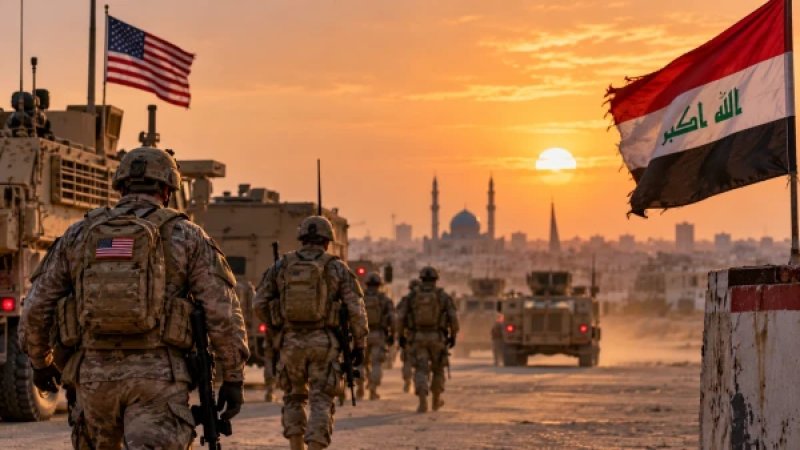
On September 30, the U.S. is completing the withdrawal of its troops from the last bases in Iraq. This marks the end of yet another — and possibly the last — chapter of the American military presence in the country, which began with the invasion in 2003. However, the U.S. withdrawal simultaneously raises concerns about the strengthening of pro-Iranian armed groups and the possible resurgence of the Islamic State. As reported by [Reuters](https://www.reuters.com/world/us-forces-exit-iraq-emboldening-irans-proxies-islamic-state-2026-09-30/), the last American units are leaving the remaining bases in Iraq on September 30. The withdrawal is being carried out in accordance with an agreement reached between Washington and Baghdad in 2024. The American military presence in Iraq has lasted, with interruptions, for more than two decades. In 2003, a U.S.-led coalition invaded the country and overthrew Saddam Hussein's regime. In the following years, American troops had to fight first against supporters of the former regime, then against Al-Qaeda and other groups amid a bloody inter-religious conflict. At the peak of the operation in 2007, there were more than 170,000 American soldiers in Iraq. ### Left — and Returned At the end of 2011, the U.S. had already withdrawn its troops from Iraq. It seemed that the American military campaign was over. But less than three years later, the situation changed. In 2014, Islamic State militants captured vast territories in Iraq and Syria. At the request of the Iraqi authorities, American troops returned to the country at the head of an international coalition. After the defeat of the territorial caliphate, the number of American troops gradually decreased. In recent years, about 2,500 American soldiers remained in Iraq. Most U.S. bases had been closed or handed over to the Iraqi side earlier. Until now, several hundred American troops remained primarily in the autonomous Iraqi Kurdistan. Now they are leaving as well. ### Iraq Declares "Days of Sovereignty" For Baghdad, the withdrawal of foreign troops has great symbolic significance. Iraqi authorities announced that starting October 1, the country enters a new period, during which there will be no foreign military contingent on its territory. On the occasion of the mission's completion, the authorities declared four days of "Days of Sovereignty." However, behind the festive rhetoric lies a much more complex question: can Iraq ensure its own security after the Americans leave? ### Kurds Fear Being Left Without Protection The authorities of Iraqi Kurdistan perceive the U.S. decision with particular concern. The Ministry of Peshmerga officially warned that American units are leaving at a highly sensitive moment for the region. Kurdish authorities claim that against the backdrop of the conflict between the U.S., Israel, and Iran, more than a thousand drone and ballistic missile strikes have been carried out in the region. Moreover, after the Americans leave, no alternative air defense system will be created. In Erbil, there are fears that the region will become much more vulnerable to possible new attacks. ### Concerns About ISIS Remain The second issue is the Islamic State. Although the caliphate established by the militants was destroyed nearly ten years ago, the organization itself has not completely disappeared. Its underground cells continue to operate in Iraq. American troops provided Iraqi forces with intelligence data, aerial surveillance, and information about the movements of militants. Now, Iraqi security forces will have to carry out this work independently. Former Iraqi military personnel warn that a particularly dangerous scenario could arise if militants acquire strike drones while Iraq's air defense capabilities remain limited. ### In Tehran, the U.S. Withdrawal is Seen as a Victory Iran and its affiliated Iraqi groups view the situation quite differently. Tehran has long sought to end the American military presence in neighboring Iraq and now portrays the U.S. withdrawal as a victory for its policy. Reuters notes that the influence of Iran-backed Shiite armed groups in the country remains significant. This is why some experts fear the emergence of a security vacuum: the U.S. withdrawal could provide these groups with additional opportunities to enhance their political and military influence. ### Soldiers Have Left, but U.S. Influence Remains However, the end of the military presence does not mean the disappearance of American influence in Iraq. Iraq's oil export revenues still pass through the country's central bank accounts at the Federal Reserve Bank of New York. Oil revenues account for about 90% of Iraq's state budget, so the financial connection with the American system gives Washington significant leverage even after the last troops have departed. Thus, on September 30, 2026, the American military presence in Iraq comes to an end, but American influence over the country does not. The main question now is what will replace it: a more independent Iraq or a new balance of power in which Iran and its affiliated armed groups play a significantly larger role.
