

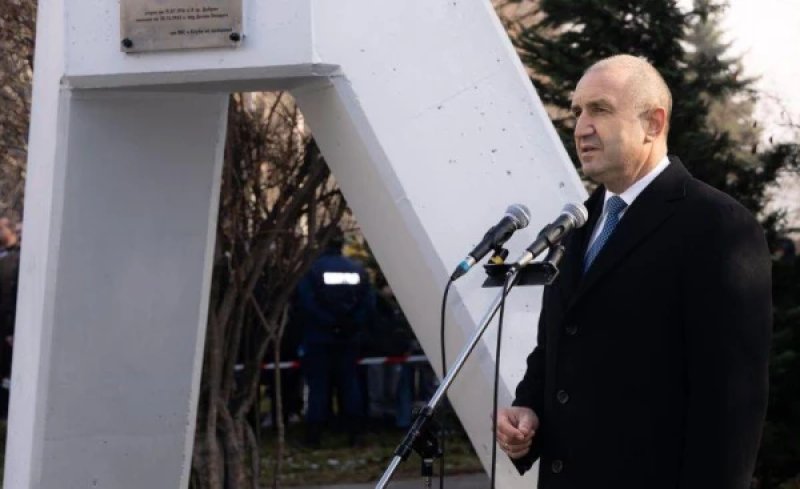
The European Union should engage more actively in diplomatic dialogue with Russia to end the war in Ukraine and prevent a devastating nuclear strike, said Bulgarian Prime Minister Rumen Radev at the Euronews summit on defense and space. Russia controls the largest nuclear arsenal in the world: it is estimated that it has about 4,400 warheads, of which 1,796 are deployed on strategic carriers. Rumen Radev also criticized the ongoing supply of weapons and ammunition to Ukraine, calling it a failed strategy of "peace through strength." "There is a limit to the simple transfer of weapons and support because the final architecture of peace will be formed by diplomacy, not by arms supplies. Therefore, we call for more listening to each other, opening channels of communication," said the Bulgarian Prime Minister. "The problem is that no one raises the issue of nuclear risk. Does it exist? Maybe not, I don’t know, but it is a risk." "We must always consider the worst-case scenario. Are we ready for it? Is anyone even talking about risk assessment? Does it exist? After all, we are trying to achieve a conventional victory over the largest nuclear power," he added. Rumen Radev recalled the statement by Russian Foreign Minister Sergey Lavrov, who said that a war between Russia and Europe would be "completely different" and "very short" – words perceived as a veiled nuclear threat. The Bulgarian Prime Minister criticized "such a manner of speaking" from the Kremlin but urged his colleagues, European leaders, to think about what further escalation could lead to. Tensions are rising as Moscow intensifies hybrid attacks against European countries, aiming to sow fear in society and weaken military support for Ukraine. "There is a nuclear trump card," said the Bulgarian Prime Minister, noting that Russia may try to play it if it finds itself weakened or cornered. "We must take this into account. We cannot close our eyes to the fact that there is nuclear weapons on our continent, that nuclear warheads are in Russia's arsenal. And this is part of the calculation in this game," emphasized the Prime Minister. Since his election earlier this year, Rumen Radev has been among the minority of politicians advocating for more active diplomatic engagement with Russia to end the full-scale invasion of Ukraine. Dialogue is also supported by the authorities of Slovakia, the Czech Republic, and Austria. Others, on the contrary, believe that the Kremlin is little interested in substantive negotiations and continues to insist on maximalist demands. A brief meeting last week in New York between German Foreign Minister Johann Wadephul and Russian Foreign Minister Sergey Lavrov ended with harsh mutual accusations. Attempts by the White House to achieve a temporary ceasefire have been unsuccessful. Instead, Russia has effectively blocked the Black Sea and is conducting continuous airstrikes on Ukrainian cities. Apparently, Rumen Radev is not deterred by these failures and insists that Europe should rethink the balance of its "military, economic, and diplomatic tools," prioritizing diplomacy. He also rejected the label of "pro-Russian" politician attached to his government, which this year vetoed sanctions against Patriarch Kirill. "The war in Ukraine has been a test for our critical thinking and realistic approach," he noted. "It has called into question our ability to assess the strategic center of gravity of the opponent. Above all, it has revealed how difficult it is to formulate achievable political goals, translate them into a thoughtful military strategy, and determine the desired outcome of the conflict." "We have not yet exhausted the potential of diplomacy and must act and speak much more actively," emphasized the Bulgarian Prime Minister.
