

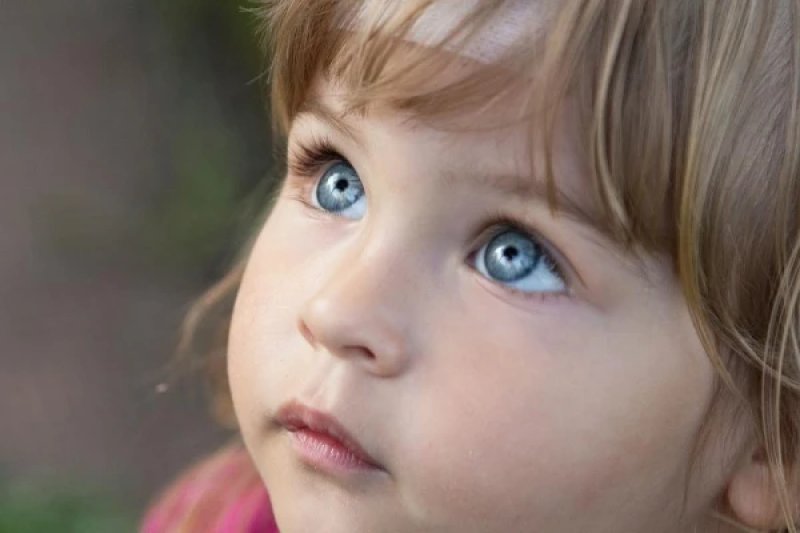
When Children's Eye Color Changes Immediately after birth, a child's vision functions are not yet developed. Until three months, they can only see light spots, and by six months, they begin to distinguish shapes. Many children are born with blue or blueish eyes. This is because there is very little color pigment melanin in the infant's body. Over time, the eye color begins to change, and by the age of three, it is finally established. If you have a blue-eyed baby, do not hope that this color will remain — it is quite possible that by the age of one, they will have brown eyes. If the infant is born with brown eyes, the probability that this color will remain in the future is 90 percent. How the Eye Color of a Newborn Changes It is important to remember that eyes cannot become lighter! Immediately after birth, melanin begins to be produced in the child under the influence of light, which gives the eyes the shade determined by genes. In the womb, there was no ultraviolet light, which is why most European infants have light eye color. The iris darkens for everyone, but for some, it takes on a golden or copper hue, while for others, it becomes blue, gray, or green. Blue-eyed: for children with genes predisposed to blue eye color, changes occur most often. Parents may not even notice how the eyes change shade from pale blue to deep blue, gray-blue, or even turquoise. The light color is the most “deceptive.” The shade will not become permanent at one year or even at three. There are cases when the color changes even after 5 years. However, by 1.5 to 3 years, parents will be able to determine whom the child resembles — the direction will be clear, and the chances that a blue-eyed three-year-old will change their eye color to dark brown are virtually nonexistent. But whether it will be sky blue or gray-blue will become clear later. Brown-eyed: by two months of age, the melanin in children reaches a volume that allows for determining the future eye color. If by this time the eyes have taken on a warm hue, one can expect their further transformation into brown. By three years, these children will have the eye color that will last a lifetime. Green-eyed: green is a “wandering” color. Especially if the parents have different eye colors. The child will have either the father's or the mother's color. Conclusions can only be made when the child turns three years old. Gray-eyed: this color appears in the child by six months if it is encoded in the genes. It rarely changes, except that it may darken slightly over the years, but it will not turn blue or brown. How to Predict What Eye Color a Newborn Will Have We talked about melanin and its influence on future eye color. The iris does not darken instantly — it is a slow process. But conclusions can be drawn when the baby turns six months old. The future eye color can be seen in speckles. If small brown spots appear on the iris, then the transformation of your blue-eyed baby into a brown-eyed one has already begun. The speckles can also be blue and green. How to Determine a Child's Future Eye Color The eye color of the baby is determined by genes — just like everything else. The question is whose genes will prevail: the mother's or the father's. Even if both parents have gray eyes, the child can be born with brown eyes. The child inherits genes from both parents in equal shares. However, it is important to remember the dominant and recessive traits that we studied in biology classes. The strongest dominant is brown, green is weaker, and the weakest is blue. Thus, blue-eyed children are born the least often if one of the parents (or even grandparents) has brown or green eyes. By the way, brown is the most mysterious color. It often represents a mixture of brown, green, and amber. To predict what color the baby's eyes will be, scientists have developed a special calculator. With its help, one can try to predict what the baby's eye color will ultimately be. Such patterns can be observed: — infants with brown eyes will not change color; — if both parents have brown eyes, the probability that the child will have the same is 75%; the probability of a green-eyed child is 19%; the probability of gray or blue eyes is 6%; — if one parent has brown eyes and the other has blue, there will be no green-eyed child. The baby will either have brown or blue eyes — 50-50; — if one parent is brown-eyed and the other is green-eyed, the probability that the child will have brown eyes is 50%, green is 38%, blue is 12%; — if both parents are green-eyed, the probability that the baby will have brown eyes is less than one percent, green is 75%, blue is 25%; — if one parent has green eyes and the other has blue, the child will inherit the eye color of one of them with equal probability; — if both parents are blue-eyed, the baby will have a 99% chance of being the same. One percent remains for green eyes. Of course, these are averaged data, and there are certain percentages of other variations. Can a Child Inherit Eye Color from Grandparents? Usually, parents study tables of future eye colors of their child, which only take into account the mother and father. However, it should not be forgotten that eye color can be inherited not only from parents. They carry genes laid down by ancestors. Therefore, there are situations when brown-eyed parents have a brown-eyed son, and then a blue-eyed grandson. We know that brown is dominant, while blue is recessive, meaning weaker. But a person with brown eyes can be a carrier of both genes. For example, if their mother or father, or grandparents had light eyes. No one knows when this gene will “fire.” But if there was a blue-eyed person in your family, the chances that you carry their gene (even if you have brown eyes) and then pass it on to your child are very high. It is indeed our ancestors who can gift eye color to the new generation. For example, if a brown-eyed woman had a blue-eyed grandfather, then in a pair with a blue-eyed man, she may give birth to a blue-eyed son. But if her partner is brown-eyed, the chances will be much lower. The Rarest Eye Color There are more brown-eyed people on the planet, as we learned in biology classes. In contrast, green-eyed individuals are born the least often. This is the most mysterious color because even two green-eyed people do not necessarily have a green-eyed child. But the green color can “pop up” after a generation or two. Only two percent of the Earth's population has green irises. Does Eye Color Affect Vision? Grandmothers used to say that an infant sees the world “upside down.” This is, of course, not true, but in some ways, they are right — the child does not see the world as adults do. In the first days of life, all the surrounding space and people are just blurry spots for them. They cannot distinguish individual objects, details, or faces, even though mothers and fathers would like them to. In reality, the infant looks at your face not because they recognize, fall in love, or know — they are simply trying to see. Nature has made it so that they see unclearly: underdeveloped vision is a protective mechanism to shield the newly born being from numerous visual stimuli. In the first months of life, babies see the color red best, which is why they are so fond of toys of this color. Eye color, of course, does not affect this. The peculiarities of vision in newborns depend not only on the structure of the eyes but also on the development of the brain.
