

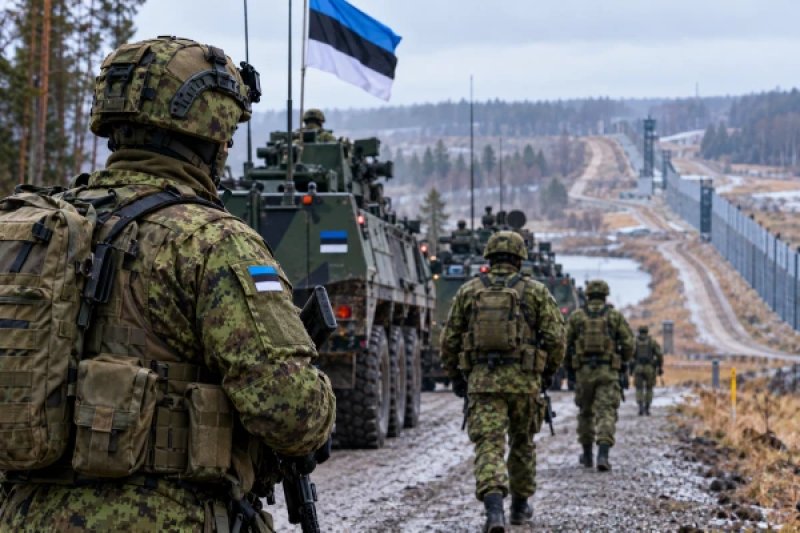
As [noted](https://www.ft.com/content/0293497e-e4b5-473e-be49-67d1fc005fae?syn-25a6b1a6=1) by the Financial Times, Tallinn is shifting from the previous model of containment and gradual exhaustion of the enemy to the concept of "active defense." The principle is to not cede territory to the enemy even at the initial stage of a potential conflict. "We must start at the border and win in the first battles," explained Colonel Tarmo Kundla, commander of the 1st Brigade of the Estonian Defense Forces. ### From Tapa - Closer to the Russian Border One of the most noticeable changes is the permanent relocation of the 1st Brigade from Tapa to Jõhvi, located about 50 kilometers from the border with Russia. New infrastructure is being created there for the military personnel. At the same time, a military facility is being built directly in Narva. About 200 military personnel will be able to be stationed there permanently, and in the event of a crisis, the number of deployed forces can be increased to around one thousand. The Estonian military is particularly considering the scenario of a limited operation against the border area. According to their assessment, the goal of such an action could be not to capture the entire country but to test NATO's readiness to fulfill its collective defense commitments. One of the most sensitive locations in such a scenario is considered to be Narva - a border city with a predominantly Russian-speaking population. ### "Deterrence is Not Working" At the same time, Estonian intelligence, according to FT, does not consider a full-scale war between Russia and NATO likely in the next two years. Concerns are primarily related to the more distant perspective and the possibility of a limited military provocation. A high-ranking representative of the Estonian military intelligence told the newspaper that the next one to four years will be a critical period for the Baltic states. The Estonian Ministry of Defense explains the new concept as a necessity to make potential aggression so risky that the enemy would abandon it even before the start of hostilities. The main goal is to prevent the destruction of war from spilling over into Estonian territory. ### Strikes Hundreds of Kilometers Away Not only is the deployment of troops changing, but also the nature of the purchased weapons. According to FT, over the past year, Estonia has signed contracts for the acquisition of nine American HIMARS launchers, including ATACMS missiles with a range of up to 300 kilometers, as well as nine South Korean Chunmoo systems of comparable range. One of the Estonian officers pointed out to journalists the geography: from Estonia to St. Petersburg is about 260 kilometers. The new doctrine assumes that in the event of an attack, Estonian forces will not only have to fight directly at the border but also strike military targets deep in the enemy's rear from the first days. ### Why the Previous Plan Was Considered Insufficient After Russia's annexation of Crimea in 2014, Estonia's defense concept was largely built on a different scenario. In the event of an invasion, it was assumed that reservists would be quickly mobilized, utilizing the wooded and marshy terrain and conducting a maneuverable defense, inflicting maximum losses on the advancing forces until the arrival of large NATO allied units. The war in Ukraine forced Estonian military officials to reconsider this approach. According to their assessment, the Russian army has demonstrated a willingness to sustain heavy losses and continue to hold occupied territory even after extensive destruction. For small Estonia, the bet on the subsequent liberation of lost areas is therefore considered too risky. Now the principle is changing: to not retreat deep into the country, but to build defenses as close to the border as possible. ### Huge Reserve with a Small Standing Army Estonia has relatively small regular armed forces - about 4,200 military personnel. However, the country has a large trained reserve. FT cites an estimate of up to 230,000 trained reservists. In the event of war or an immediate threat, about 39,500 reservists on heightened alert are expected to quickly arrive at pre-defined units with which they have trained. Another approximately 40,000 trained reservists can be used for additional deployment. At the same time, Estonia is sharply increasing defense spending. According to official data provided by the newspaper, this year they have risen by 42% - to €2.4 billion, or about 5.4% of GDP. ### The British Brought Long-Range Weapons Allies in NATO are expected to play a significant role in the new system. The United Kingdom intends to increase its military presence in Estonia from about 800 to 1,200 military personnel by April. During the Spring Storm exercises, British units also used strike drones **Nyan**. According to FT, their range reaches approximately 300 kilometers. Thus, in the event of a conflict, many military facilities in northwestern Russia fall within the range of such weapons. ### "Now We Fear the End of the War" However, the main factor that, according to Estonian military and intelligence officials, determines the level of threat to the Baltic states is the further development of the war in Ukraine. As long as hostilities continue, a significant portion of Russian ground forces remains tied to the Ukrainian front. However, if a ceasefire or peace agreement is reached, NATO will have to consider the possibility of transferring tens of thousands of Russian servicemen to other fronts. Moreover, Russia will retain a significantly expanded defense industry developed during the years of war. That is why one of the representatives of Estonian intelligence articulated the change in threat perception particularly harshly: > "We feared the war [in Ukraine]. Now we fear the end of the war." It is the period after a possible cessation of hostilities in Ukraine that Tallinn views as the moment when the military threat to the Baltic states could potentially increase significantly.
