

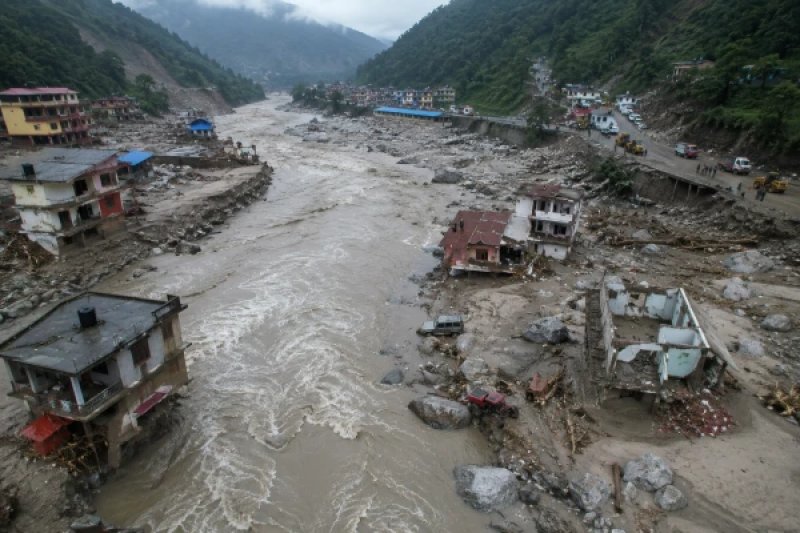
Several major media outlets in Nepal, including "OnlineKhabar" and "Kantipur," began reporting on the events that occurred on Sunday morning, and the information was later confirmed by "Reuters." Additionally, people in the Latvian Facebook group "Kalnu grupa" are warning each other about what happened last night. Initially, it was reported that there were no human casualties; however, as the situation developed, information emerged about several missing persons. According to initial reports, the flooding began around four o'clock in the morning in the municipality of Chumnubri in the Gorkha district. "OnlineKhabar" reports that local officials received information about the severe flooding around 4:35 AM. The floodwaters were filled with mud, stones, and other debris. Locals told the media that they had never seen flooding of this magnitude on the Budhi Gandaki River. ## ## Possible Cause — Landslide Blocked the River The exact cause of the disaster is still being investigated; however, the current theory is related to a landslide. The Nepal Disaster Risk Reduction and Management Authority indicates that there were no recorded precipitation levels upstream that could explain such a rapid influx of water. Initial information suggests that a landslide may have blocked the Syarkhola, one of the tributaries of the Budhi Gandaki. When the natural dam formed by the landslide broke, a massive flow of water, mud, and stones rushed down the valley. "Kantipur" reports that the possible landslide occurred between Lokpa and Chumling — in the area located on the way to the Tsum Valley. Locals also described unusual behavior of the water. "Kantipur" reports that the river seemed to be blocked several times and then released again. Individual residents reported that this cycle repeated about six times, each time causing a new surge of water. This explains the warnings that after the initial flow of flooding, the danger is not yet over. ## ## Dozens of Homes Swept Away Data on the scale of the destruction is still being collected, so figures from different sources vary slightly. "OnlineKhabar," citing local government officials, reports that more than 35 homes have been swept away in several settlements — Salleri, Baghare, and Ghatikhola. "Kantipur" later reported an initial estimate of 35 to 40 homes swept away in the vicinity of Jagat-Baghare, Salleri, and Ghatikhola. Meanwhile, "Reuters," citing official information at the time, reported about a dozen homes swept away. The discrepancies in the figures are explained by the fact that the disaster-affected region is difficult to access, and damage assessment is still ongoing. Several people hastily left their homes and moved higher into the mountains. One resident of Jagat told "OnlineKhabar" that people can only watch from a higher place as the water carries away their homes. ## ## Several Bridges Swept Away The destruction was not limited to residential buildings. The flooding destroyed several important bridges. Among them is the suspension bridge between Nyakchet and Siridibas, the bridge connecting Machhikhol to Keraudje, as well as a reinforced concrete bridge in the Soti area. A road bridge between the territories of Gorkha and Dhading was also swept away, completely cutting off traffic on this route. The energy infrastructure was also affected. In the Salleri area, the flooding impacted a hydroelectric project that was under construction. "Kantipur" reports that the camp for the 341-megawatt Budhi Gandaki hydroelectric project was also swept away. At another construction site, 18 workers were rescued after receiving timely warnings from locals and moving to a higher location. ## ## Road to Tsum Valley Blocked This disaster is particularly significant for tourists, as the flooding affected one of the most popular trekking regions in Nepal. The Manaslu Conservation Area Project, or MCAP, reported that the Manaslu trekking route has been damaged. "Kantipur" reports that the flooding swept away part of the trail from Yaru-Bagar to Jagat, and the road to Tsum Valley is blocked above Lokpa. This road is used for access to both the Tsum and Nubri valleys and further into the Manaslu region. Hotels and lodges for trekking tourists operate in the vicinity. The Jagat checkpoint reportedly was not affected by the flooding, and tourists, locals, and staff there were initially reported to be safe. The flooding occurred right in the midst of the active autumn tourist season. Manaslu is particularly popular this autumn — by mid-September, permits for climbing the 8,163-meter mountain had been issued to 466 climbers from 39 teams. This does not include all the trekking tourists who are on the Manaslu Circuit or Tsum Valley routes, so the number of foreign travelers in the broader region is even higher. ## ## There Are Missing Persons In the early hours after the disaster, Gorkha officials reported that there was no information about fatalities. However, it later became known that several people were unaccounted for. "OnlineKhabar," citing the Nepal government’s information agency RSS, reports that four people who were in livestock pens in the Ungilung-Khola area are missing. The flooding swept away four livestock shelters, as well as 15 yaks and females. Meanwhile, in more recent information, "Kantipur" mentions five people who cannot be contacted. Therefore, the exact number of missing persons may still change. ## ## People Rescued by Helicopters The Nepal Army, police, and Armed Police have been deployed to the flood-affected area. At least six people have been rescued by helicopter from the Jagat area. Rescue and evacuation efforts are ongoing, including the use of helicopters, as several locations have become difficult to access by land after the destruction of bridges and trails. Health services in the Gandaki province have put rapid response and emergency medical teams on standby. Hospitals and medical posts in Philim, Salleri, Jagat, and Machhikhol are located in higher areas and are initially assessed to be at lesser threat. ## ## Warnings Spread Significantly Downstream Nepalese authorities emphasize that the risk is not limited to the area where the flooding began. The National Disaster Risk Reduction and Management Authority has urged special caution in the areas of Siridibas, Jagat, Yari, Tatopani, Machhikhol, Soti, Arkhata, and Arughat. The Department of Hydrology and Meteorology has also sent warning SMS messages to residents along the Budhi Gandaki. Police have used loudspeakers by the river, urging residents not to approach the shore and to leave dangerous areas if necessary. The warning has been spread even further downstream — to the vicinity of the Trishuli River. Nepal's Minister of Home Affairs, Sudhan Gurung, has also publicly urged residents along the Budhi Gandaki to immediately move to safer places, specifically mentioning Siridibas, Jagat, Salleri, Khorlabeshi, Machhikhol, Soti, Arkhata, and Arughat. "Reuters" reports that warnings about the need for caution are also being spread to areas downstream — including Tanahun, Chitwan, and both districts of Nawalparasi. Currently, the most important thing is that the scale of the disaster is still being assessed. The number of destructions and information about missing persons may change; however, authorities advise people in the Manaslu area and Tsum Valley not to rely on the usual accessibility of routes and to follow the instructions of local rescue services. Thus, the warning being spread on social media about sudden floods near the Tsum Valley and the Manaslu region is not just a rumor: the event is confirmed by both local Nepalese media and officials, as well as the international news agency "Reuters."
