

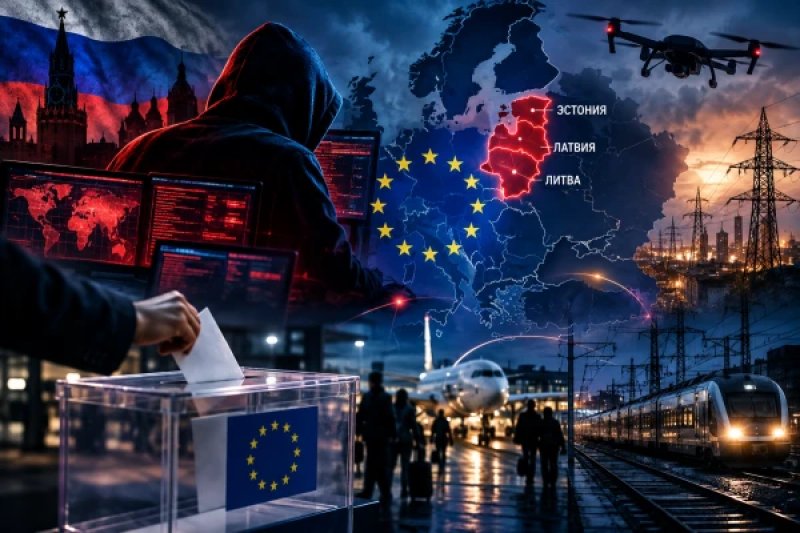
 Foto: BB.LV / Гибридные угрозы
As [reported](https://elpais.com/internacional/2026-10-12/bruselas-teme-ataques-hibridos-de-rusia-en-el-superciclo-electoral-europeo-que-se-abre-con-espana.html) by the Spanish newspaper El País, Brussels is already discussing joint countermeasures. Special attention is being paid to NATO's eastern flank, including Latvia, Lithuania, and Estonia. The European Union is preparing for a period of increased instability. Important elections are scheduled to take place in several countries soon, and this political calendar is causing concern among European officials and intelligence representatives. According to El País, Brussels believes that Moscow may exploit the electoral campaigns to increase pressure on European states, weaken support for Ukraine, and test NATO's ability to respond to provocations. This refers to the so-called hybrid warfare—actions that are not necessarily accompanied by open armed confrontation but can cause significant harm to a state. These include cyberattacks, diversions, interference in the information space, spreading disinformation, disruptions in transportation and energy, as well as incidents involving drones. The peculiarity of such operations is that it can be difficult to identify the organizers, and the line between an accidental incident and a deliberate attack often remains unclear. ## Elections Become a Moment of Special Vulnerability As noted by El País, elections are scheduled in about ten European countries during the upcoming political cycle. Among the most significant countries are France, Spain, Poland, and Italy. The publication also mentions Latvia, Estonia, Lithuania, Slovakia, the Czech Republic, Bulgaria, Slovenia, and Greece. European officials fear that electoral campaigns could become a convenient moment for conducting operations aimed at destabilizing the situation. Moreover, this does not necessarily involve attempts to directly change the voting results. According to sources cited by the publication, a more likely scenario could be cyberattacks or diversions that disrupt the normal life of citizens, cause anxiety, and intensify political contradictions. For example, disruptions in transportation, energy networks, or government information systems just before the elections could influence public sentiment, even if the voting procedures themselves remain protected. One senior European official warned reporters that states preparing for elections could become particularly attractive targets for hybrid operations. ## Why Are the Baltic States at Risk? Latvia, Lithuania, and Estonia occupy a special place in the European security system. All three states are located on NATO's eastern flank, support Ukraine, and pay significant attention to border protection, critical infrastructure, and information space. Moreover, the region has already faced incidents related to drones, cyber threats, and attempts at information influence. According to European sources cited by El País, the danger of hybrid operations increases for states located closer to Russia, Belarus, and Ukraine. For Latvia, this means the need to consider not only traditional military threats but also the possibility of disruptions in civil infrastructure. Potential targets for such actions could include transportation hubs, energy systems, telecommunications, and digital government services. It is important to emphasize that the publication by El País does not contain information about a specific disclosed plan to attack Latvia. It is about risk assessment and the preparation of European states for a possible deterioration of the situation. ## France Is Already Preparing to Protect Elections One of the countries most openly warning about the threat of foreign interference is France. Ahead of the upcoming presidential elections, the authorities have created a special coordination structure led by Prime Minister Sébastien Lecornu. Its task is to assess threats and coordinate the actions of government agencies. Paris is also preparing additional legislative measures to protect the electoral process. Particular attention is being paid to digital manipulation, the spread of false information, and attempts to influence public opinion via the internet. In France, the state service VIGINUM operates, which is responsible for detecting foreign digital interference. According to El País, it has already identified information operations that French authorities link to Moscow. President Emmanuel Macron has also ordered an increase in preparedness for emergencies affecting transportation, energy, and telecommunications. ## Poland Warns of Drone and Missile Provocations Poland takes the presumed threat particularly seriously. Prime Minister Donald Tusk previously stated that, according to European intelligence assessments, Russian plans may include hybrid attacks using drones and missiles against states supporting Ukraine. According to the Polish Prime Minister, the aim of such actions could be to test the allies' readiness to activate NATO's collective defense mechanisms. Warsaw is also concerned about attempts to present deliberate incidents as technical errors or accidental violations of airspace. Polish authorities have already strengthened measures to protect electoral processes. In 2025, the state agency NASK, which analyzes digital threats, identified information operations whose content matched Russian propaganda narratives. Now, Polish security services are considering such threats in a broader context—alongside diversions, cyberattacks, and disruptions of infrastructure. ## Germany Has Faced Disturbing Incidents Germany has also come under the scrutiny of European security services. In recent months, incidents involving drones and transportation infrastructure have been recorded there. Particular concern has been raised by events around Leipzig-Halle Airport, which is crucial for cargo transport. European officials view such incidents as examples of threats that could complicate logistics and aid supplies to Ukraine. At the same time, the circumstances of each incident require separate investigation: suspicions of involvement by Russian structures cannot be automatically considered established fact. German Chancellor Friedrich Merz has warned of the possibility of serious hybrid attacks. According to El País, Brussels considers further attempts at pressure to be quite likely. ## Italy Reports a Rise in Cyberattacks Italian authorities are also ramping up preparations for hybrid threats. According to El País, the Italian Ministry of Foreign Affairs was subjected to a large-scale cyberattack, which is linked to the pro-Russian hacker group NoName. Such attacks have previously affected government institutions, transportation, the financial sector, telecommunications, and energy. The Chief of Staff of the Italian Army, General Carmine Maziello, stated that the number of cyberattacks in the country has increased by 40%. Defense Minister Guido Crosetto advocates for more active preparation of the armed forces to counter hybrid operations. The Italian government has introduced a bill aimed at adapting the army to new threats. It is expected to be adopted in 2027. ## Europe Has Weaknesses One of the most serious problems remains the lack of coordination among national security systems. El País has reviewed a confidential document on European defense preparation, which lists the vulnerabilities of EU states. Among them are a shortage of specialists, incompatibility of certain technical systems, dependence on foreign technologies, and the absence of a unified secure European cloud infrastructure for defense needs. Particular concern is raised by the capabilities to counter cyberattacks, electronic warfare, as well as threats related to artificial intelligence and new technologies. The problem is that individual states can effectively protect their own systems but may not always be able to quickly combine efforts in the event of a large-scale cross-border attack. That is why Brussels is discussing the creation of more coordinated response mechanisms. ## How Will the EU Respond? European diplomats are considering several options for joint actions. Among them are emergency meetings of heads of state and government, additional sanctions, the deployment of specialized response teams, and strengthening the protection of critical infrastructure. The possibility of more rapid movement of military units and equipment within Europe in the event of a serious crisis is also being discussed. European Commission President Ursula von der Leyen previously announced the preparation of new crisis response mechanisms and a pan-European security strategy. However, the establishment of a full-fledged European Union Security Council remains a subject of discussion. The question of a military response is significantly more complex. If an attack on a NATO state is recognized as an armed attack, allies may consider invoking Article 5 of the North Atlantic Treaty. However, many hybrid operations fall below the threshold of open military conflict. Such situations pose a particular problem: a state may suffer significant damage, but the grounds for a collective military response may be contentious. According to El País, European officials are discussing ways to respond to such actions without allowing uncontrolled escalation. ## The Main Question Is Whether Europe Will Withstand the Test According to sources from the Spanish publication, the possible intensification of hybrid operations is aimed not only at individual states. A broader intended goal is to test the political cohesion of the European Union and NATO's ability to make joint decisions. This scenario becomes especially sensitive against the backdrop of disagreements between European capitals and Washington regarding the future of American military presence in Europe. For the Baltic states, this has immediate significance: the security of the region largely depends on the speed and coordination of allies' responses. Europe is preparing for a situation in which a serious crisis may not begin with an open military attack but with a series of cyberattacks, diversions, incidents involving drones, and information provocations. Latvia and other Baltic states are among those that need to pay particular attention to such risks. However, assessments from European officials remain a warning of possible scenarios rather than evidence that a specific attack is already being prepared.
