

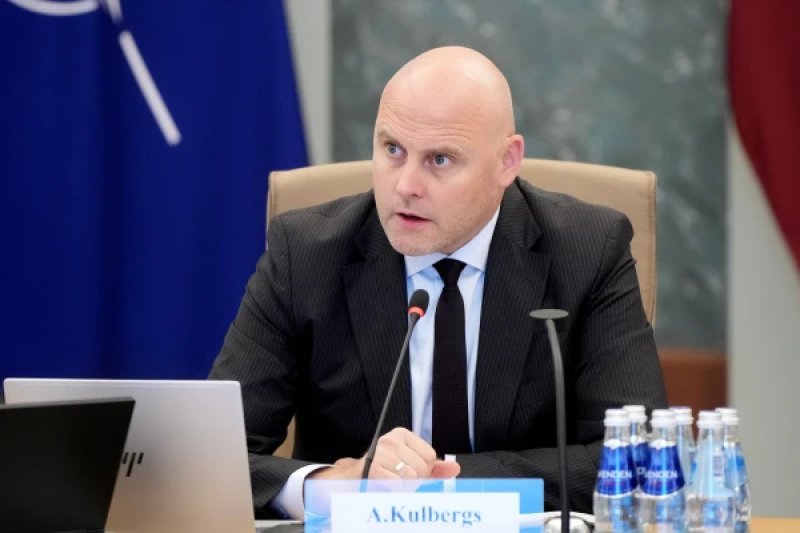
 Foto: BB.LV / Тише едешь - дальше будешь?
## Three Reasons for the Premier's Patience There were no negotiations last week, and none are planned for this week either - the premier has switched from internal politics to external, as he will participate in a European Council meeting tomorrow. It is not certain that negotiations with potential partners for the division of power will begin next week either. What explains Kulbergs' pause? Let’s name three main reasons. **First** - Kulbergs and Co have decided that a pause is needed for emotions accumulated during the election campaign to settle, so that negotiations can be conducted in a calmer environment. Moreover, the president will not entrust Kulbergs with forming a government until after November 3, as only on November 3 will the 15th Saeima take office, and the previous government will announce its resignation. As they say, why rush?! **The second reason**. The United List (UL) is not a monolithic party, but a coalition consisting of three parties and one non-governmental organization, which, by the way, is led by Kulbergs himself, while he remains formally non-partisan. This means that it is necessary to coordinate the position on the composition of the future ruling coalition with influential representatives of all three parties. This also takes time. Additionally, according to rumors, some politicians from the parties within the UL do not wish to see "New Unity" in the government. After all, this contradicts the will of the voters. Voters of "New Unity" did not vote for the UL in this election just to see "New Unity" back in power as if there had been no elections! And **the third** - the most important - reason: Kulbergs wants to have a nearly ready draft declaration of the new government in hand by the start of power-sharing negotiations, listing all, in Kulbergs' own words, unpopular decisions that need to be made. As the premier stated, the coalition will include those who agree to sign this "killer" document. In other words, first, let’s agree on the work plans, and in the evening we will divide the posts. Kulbergs described the current situation as historical, as a significant part of society expressed support for change in the elections. ## Declaration of Tough Decisions What might be in this declaration that the old-new premier is already actively working on with his colleagues from the UL? Kulbergs himself outlined three priorities: * streamlining state finances, * security, * economic growth. As for security, there will be no discussions: the new government, as President Rinkevics insists, must provide for defense funding in the 2027 budget at 5% of GDP. This year, such a level of defense spending was achieved mainly through borrowed funds. Apparently, military needs will also be funded primarily through loans next year. When it comes to "streamlining state finances," it primarily refers to cutting expenses. The current Saeima has approved an increase in state spending next year by 441 million euros. But the problem is that such additional funds are not available in the budget and are not expected. This means that even the healthcare sector cannot expect an increase of nearly 200 million euros. What to do? Kulbergs is determined to sharply cut spending on state procurement. It may also be necessary to reduce various tax benefits - possibly even for families with children... Although it is not certain that Kulbergs will dare to do this. On the other hand, as the president noted, the new government will have two years to implement reforms and carry out radical changes. After all, there is now a pause in the series of elections: the next elections for local governments and the European Parliament will not take place until 2029! ## It’s Time to Change the Whole System Along with cutting state procurement expenses, Kulbergs wants to radically change the management system of state enterprises. This may involve reducing the number of members on the boards of state enterprises, merging several enterprises, changing the subordination system (for example, state clinics could report directly to the Ministry of Health), as well as changing the system for selecting board members. This will not yield huge savings, but it will increase the efficiency of state enterprises. Kulbergs also plans to reduce the number of ministries. In particular, this involves the abolition of the Ministry of Climate and Energy, with its functions transferred to the Ministry of Smart Governance and Regional Development and the Ministry of Economy. The National Alliance proposes to create a single Ministry of National Economy altogether, abolishing the Ministry of Economy, the Ministry of Agriculture, and the Ministry of Transport. ## But How Will We Earn? All this is interesting, but Kulbergs, a former entrepreneur, understands that it is necessary to think not only about how to spend less but also about how to earn more. To this end, the premier proposes creating a Development Fund, which would accumulate funds for investment in various promising projects. Where will the money for these investments come from? It could be the second pension level funds, which banks currently mostly invest abroad. Additionally, according to Kulbergs’ plan, a source of funding could be investments from foreign investors under a program for investments in exchange for residency permits. By the way, two potential partners of the UL - the National Alliance and "New Unity" - are categorically opposed to "golden visa trading." Will this become a stumbling block on the way to forming a coalition of "three"? We will find out soon! It is clear that Kulbergs, in order to somehow balance the budget against the backdrop of very modest economic growth, will have to cut expenses on state administration (abolish bonuses, cash prizes, and salary increases) and possibly reduce the state administration apparatus itself. ## The Cost of a Mistake Yes, Kulbergs and Co have indeed set a record for the number of seats won in parliament - 41! But this victory has created a significant headache: the level of expectations from voters for Kulbergs and his associates is extremely high. This means that the cost of a mistake could also be very high. "If we do not implement the changes that voters expect, if we let them down, we may not be in the next parliament at all!" - honestly admitted one of the leaders of the UL, Edgars Tavars. Realizing this, Kulbergs is not in a hurry to choose partners for the division of power... ## To Hold Out Until... 2030? Meanwhile, if Kulbergs does not make any fatal mistakes and there is no split in his political coalition, he has a good chance of staying in the prime minister's chair until the next elections, that is, until 2030. In any case, given the existing contradictions, it will be practically impossible to form another government in the new Saeima without the United List.
