

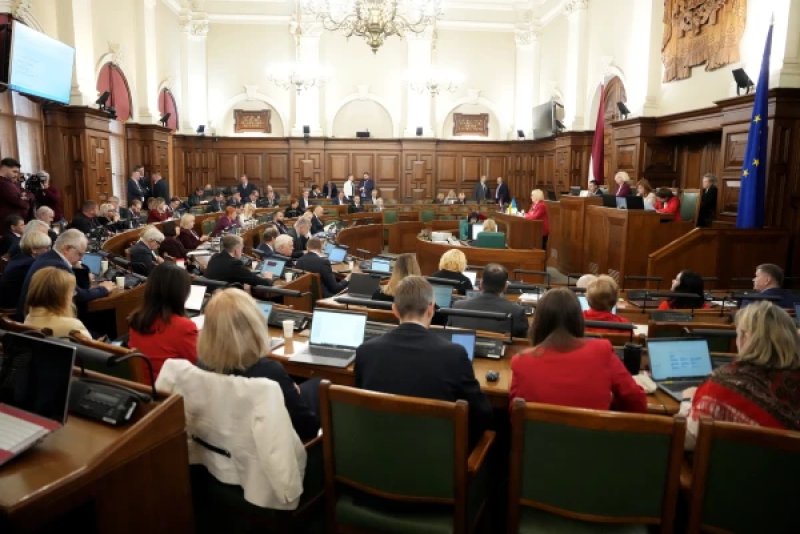
 Foto: BB.LV / Пленарное заседание Сейма
Although the powers of the current, 14th Saeima officially end on November 3 - with the start of the powers of the 15th Saeima, in fact, the parliamentarians of the outgoing Saeima will complete their work on October 29, when the last plenary session will take place and the servants of the people will take a photo for posterity before their 'dismissal'. It is worth noting that 60 percent of the current deputies will not make it to the new Saeima, so they will soon transition to the 'status' of ex-deputies. However, the current deputies are still engaged in legislative work. Moreover, they suddenly decided to do what they had not done... for years! Thus, tomorrow the Saeima's Economic Commission will ask the parliament to give the green light to changes in the Ports Law, which have been discussed... for at least the last five years - since the time of the 13th parliament, when, at the behest of the 'reformers' from the New Conservative Party, the municipalities were stripped of their ports and they were completely transferred to the state. Now it is proposed to 'return' the ports to the municipalities or, more precisely, to 'divide' the responsibility for managing the Riga, Ventspils, and Liepaja ports between the state and the municipalities. Specifically, it is proposed to create a Port Council, which will consist of three members from the state (the Ministry of Economics, the Ministry of Transport, and the Ministry of Finance) selected through an open competition and three members from the specific municipality. It is obvious that the current Saeima will not have time to adopt these and other changes to this law. So what was the point of initiating the process? Why couldn't they wait for the new Saeima to start its work? The 'awakening' before dismissal also occurred in the Saeima's Legal Commission, whose deputies suddenly began to consider amendments to the Saeima's Rules of Procedure (Kārtības rullis). In particular, the deputies propose to 'reform' the compensation system for the servants of the people and, for example, to limit the time for debates among deputies during the budget review. In other words, the outgoing deputies are trying to instruct the new deputies on how to work and what the order of remuneration for their work should be. This is, at the very least, inappropriate! Nevertheless, the Saeima plans to consider these amendments at its penultimate meeting on October 22.
