

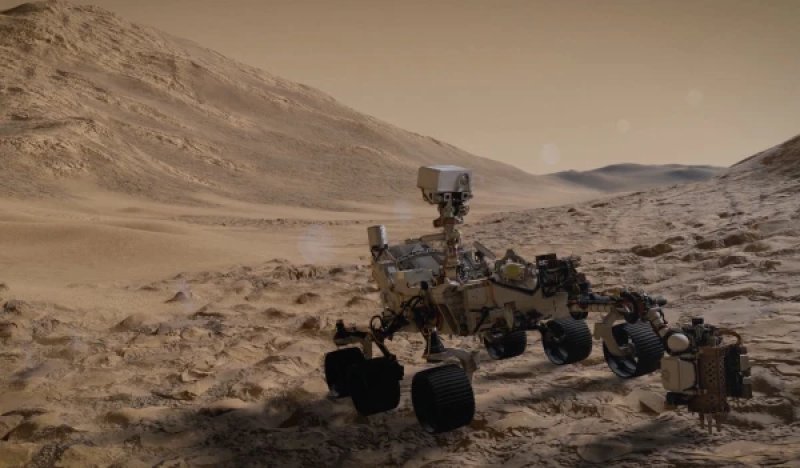
 Foto: BB.LV / Perseverance
NASA scientists believe that the Perseverance rover may have already collected the most promising sample in the history of Mars exploration in the search for signs of extraterrestrial life. However, the answer to the question of whether life ever existed on the Red Planet may be postponed indefinitely. This concerns the rock sample "Sapphire Canyon," which Perseverance retrieved in the area of the ancient river valley Neretva within the Jezero crater. More than three billion years ago, a lake existed here, making this region one of the most promising for the search for traces of ancient life. According to mission participants, this is exactly the type of rock that scientists hoped to find. Researcher Adrian Brose called the discovery the first potential biosignature found on Mars. > "I think this is the first time we’ve found something on Mars that can be classified as a 'potential biosignature'," he stated. Particular interest is drawn to the dark spots in the rock, resembling a "leopard" pattern. On Earth, similar structures often form as a result of microbial activity. However, scientists emphasize that similar traces can also arise without the involvement of living organisms — due to chemical and geological processes. Therefore, a definitive answer can only be obtained after laboratory analysis on Earth. This is where the main problem arises. Although the samples have already been collected and are securely stored inside the rover, the NASA and European Space Agency program for their return has proven too expensive and complex. After years of development and billions in costs, the agency first revised the project and then effectively abandoned the original plan without presenting a full replacement. According to scientists, the instruments installed on Perseverance are insufficient to definitively determine the origin of the discovered structures. > "We can continue to conduct these studies and find these clues, but we will never know for sure until we get these samples back," noted Purdue University professor Briony Horgan. Meanwhile, NASA has a serious competitor. China plans to launch the Tianwen-3 mission in 2028 and hopes to deliver the first samples of Martian rock to Earth as early as 2031. A separate expedition is being prepared for this, featuring a lander, an ascent vehicle, a helicopter, and an orbital module that will return the samples to Earth. Despite the cancellation of the original program, NASA has not abandoned the idea of returning the Perseverance samples. The new head of the agency, Jared Isaacman, called the delivery of Martian rocks to Earth potentially the most significant scientific breakthrough in human history. Additionally, several private companies are already offering cheaper options for such a mission. One of the projects envisions delivering all 30 collected samples to Earth by 2037 for less than $3 billion. Even if the samples do not reveal traces of ancient life, they will help scientists understand why evolution on Mars may have proceeded differently than on Earth. Therefore, the rocks collected by Perseverance are already being referred to as one of the most valuable scientific materials in the history of space exploration.
