

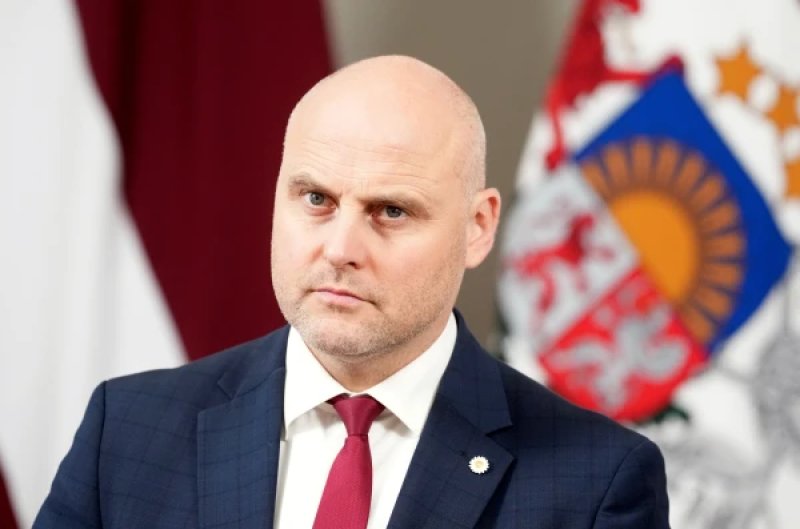
 Foto: BB.LV / Андрис Кулбергс
In his opinion, Moscow is trying to intimidate European politicians and society to make Europe abandon its support for Ukraine. The discussion about the security of Latvian leaders was prompted by reports of the prevention of possible assassination attempts on the Prime Minister and Minister of Defense of Poland. Kulbergs stated this on Wednesday, October 14, after a meeting with the President of Latvia, Edgars Rinkēvičs. Journalists asked the state leaders whether they were concerned about their own safety in light of recent events in Poland, where law enforcement detained a man suspected of threatening Prime Minister Donald Tusk and Minister of Defense Władysław Kosiniak-Kamysz. Kulbergs replied that he does not feel fear. > “I work for the good of my country, guided by the best intentions and its interests,” emphasized the Prime Minister. At the same time, he acknowledged that Russia knows how to threaten and uses intimidation as a tool to pressure European states. According to Kulbergs, the goal of such actions is to instill fear, uncertainty, and anxiety among Europeans, forcing them to abandon further support for Ukraine. The Prime Minister also expressed the opinion that Russian President Vladimir Putin himself feels fear due to the failures of the Russian army on the front. That is why, Kulbergs believes, Moscow resorts to other methods of influence in various countries in Europe. ## Rinkēvičs: High positions entail certain risks President of Latvia Edgars Rinkēvičs agreed with the Prime Minister that state leaders must be aware of the possible threats associated with their positions. According to the President, by taking on the responsibility of leading the country, high-ranking officials also accept certain risks. However, Rinkēvičs did not comment in detail on the events in Poland. He emphasized that it is necessary to wait for the results of the investigation being conducted by competent Polish authorities. ## A man threatening the country’s leaders was detained in Poland The discussion about possible threats to Latvian politicians was prompted by events on October 11 in Poland. On that day, Polish law enforcement detained a man as part of an investigation into threats of a possible attack on Prime Minister Donald Tusk and Minister of Defense Władysław Kosiniak-Kamysz. Tusk himself reported the detention on the social network X. > “The man who threatened an attack has been detained,” wrote the head of the Polish government, thanking the police for their swift and decisive actions. The Polish Ministry of the Interior reported that the police received information from the Government Protection Bureau about a possible threat to the lives of two high-ranking politicians. The press secretary of the minister-coordinator of special services, Jacek Dobrzyński, stated that, according to the authorities' assessment, there was a high probability of the threat being realized. That is why law enforcement made the decision to immediately detain the suspect. At the same time, the results of the investigation do not yet allow for definitive conclusions about the motives of the detainee and possible involvement of foreign states. ## Threats will not change Latvia’s position Despite reports of possible assassination attempts on European politicians, Kulbergs made it clear that he does not intend to change his position under the influence of threats. According to him, spreading fear and uncertainty is one of the tools of pressure that Russia seeks to use to weaken European support for Ukraine. The President of Latvia, for his part, emphasized the need to wait for the establishment of all the circumstances of the Polish case. Thus, Latvian leaders acknowledge the existence of risks associated with their positions but do not consider them a reason to abandon their duties.
