

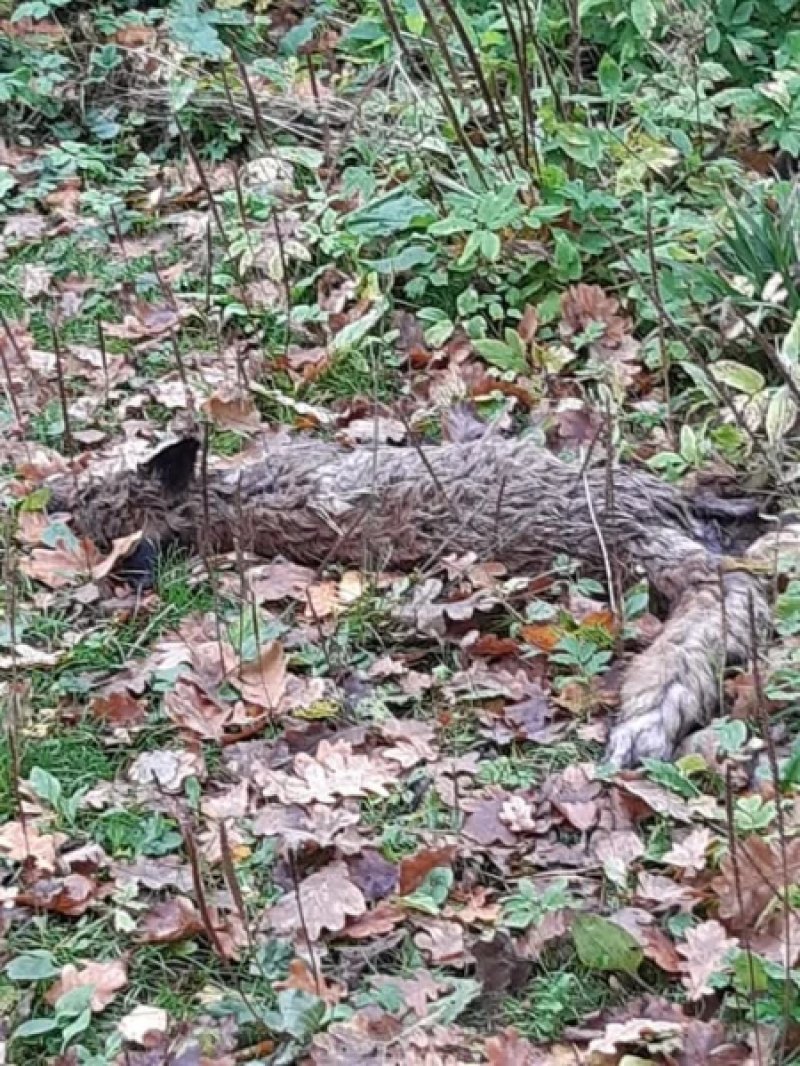
 Foto: BB.LV / Дохлая лиса
The Food and Veterinary Service of Latvia previously confirmed cases of carnivore plague among foxes in this region. However, a debate has erupted on social media: some are worried about their pets, while others suspect that the animals are being deliberately poisoned. A troubling message appeared in the Facebook group "Riga Dog Owners Club." Its author described the situation in the village of Gauja, located near Carnikava. According to the woman, a warning about an outbreak of carnivore plague among foxes had already circulated in the Adazi region. However, she soon faced the consequences of what was happening. "On Sunday, I discovered a dead fox just a few meters from my gate in the woods. I won't even mention how difficult it was to reach the responsible services to have it removed. Sunday," wrote the local resident. She stated that the employee who arrived to collect the deceased animal reported that more than 20 dead foxes had already been found in the area. "I don't even want to think about how many are in the thickets, bushes, and places where no one can see them! This is the village of Gauja, by the way," the woman added. But she was even more alarmed by her next encounter with a wild animal. "Yesterday, I saw another fox — drooling to the ground, walking unsteadily," she recounted. The resident noted that almost all her neighbors have pets — dogs or cats, so what is happening raises serious concerns. The woman was particularly outraged by the comments of people who do not take the warnings seriously and consider reports of the disease to be exaggerated or an attempt by veterinarians to profit from vaccinations. "I am horrified by human carelessness! You are all panic-mongers, and this is yet another scam to extort money from veterinarians, whose vaccines have been sitting on the shelves, and it's all nonsense... It just makes my hair stand on end from human stupidity! Take care of your animals, refrain from walking in the woods in this area!" she urged. ## "I no longer go into the woods": dog owners are concerned The publication sparked lively discussion. Many residents thanked the author for the warning and shared that they had already changed their usual walking routes. "Thank you for the information. I live in Carnikava, and I don't even go into the woods with my dog after the first news, and now I see that the panic is not without reason," wrote one participant in the discussion. Others admitted that they regularly walk their pets in this area. "I often walk my dog there... I rented a summer house. She is always looking for foxes. We live very close," one user shared. Another commentator reported that the situation with foxes in the Olaine region is currently calm; however, according to him, there are problems with leptospirosis. The user did not provide official data to support this statement. ## "Are they just being poisoned?": social media debates the causes of death Despite official reports of the disease, some users doubt that carnivore plague is the cause of death for all the discovered animals. "There are suspicions that they are just being poisoned," suggested one participant in the discussion. "Plague and drooling — to me, that's a bit different. They are probably being poisoned," wrote another. Some commentators speculated that the foxes might be dying at the hands of animal abusers or poachers. However, no evidence of such actions was presented. Another theory was mentioned — hunger and exhaustion. "Has anyone thought that the foxes are dying from hunger?" one user inquired. "If foxes were eating well, they would be sick less often. I recently saw several that were as thin as sticks," another recounted. Meanwhile, excessive salivation, unsteady gait, and unusual behavior alone do not allow for a definitive diagnosis. Such symptoms can be observed in various diseases and poisonings, so laboratory tests are necessary to establish a diagnosis. ## Carnivore plague in foxes has indeed been detected The residents' fears have an official basis. On September 23, the Food and Veterinary Service of Latvia (PVD) reported that carnivore plague had been laboratory-confirmed in foxes in the Adazi region. Additionally, the pathogen of listeriosis was found in the examined animals. Initially, the unusual behavior of the animals raised suspicions of rabies. However, laboratory tests did not confirm rabies in the examined foxes. Carnivore plague is a dangerous viral infection affecting dogs and some wild predators, including foxes. Infected animals may exhibit high fever, nasal and ocular discharge, digestive disturbances, difficulty breathing, seizures, loss of coordination, and behavioral changes. In severe cases, the disease can lead to the animal's death. For humans, the carnivore plague virus poses no danger; however, it can be transmitted to susceptible domestic animals, primarily dogs. Puppies and unvaccinated dogs are particularly vulnerable. It is important to note that carnivore plague should not be confused with rabies — these are completely different diseases. ## "What is there to fear if the animals are vaccinated?" Another topic of discussion was the vaccination of pets. "What is dangerous if domestic animals are vaccinated, even if this strain spreads to them?" one participant inquired. Other users also urged not to panic but to vaccinate their dogs in a timely manner. "Get your animals vaccinated. There are good vaccines against plague in the EU. And leave wildlife alone," wrote one commentator. Vaccination is indeed the primary means of preventing carnivore plague in dogs. However, even vaccinated pets should avoid contact with sick wild animals and their carcasses. It is also important to consider that the rabies vaccine does not protect against carnivore plague. Dog owners need to check whether protection against this disease is included in their pet's current vaccination schedule. ## "Animals are suffering, and people only care about their own" Another perspective was voiced in the discussion: some users reminded that what is happening represents a tragedy not only for pet owners but also for the wild inhabitants of the forest. "Animals are suffering, and people only care about their own," wrote one participant in the discussion. Other commentators expressed concern about the overall state of nature and potential problems in the ecosystem. However, specialists warn that attempting to catch, treat, or feed a wild animal showing signs of severe illness is dangerous. In such situations, it is necessary to contact the responsible services. ## What to do for dog and cat owners The Food and Veterinary Service recommends that dog owners ensure their pets are vaccinated against carnivore plague in a timely manner. During walks in areas where sick foxes have been found, dogs should be kept on a leash and prevented from contacting wild animals, animal carcasses, and potential sources of infection. If a dog has come into contact with a suspicious animal or shows signs of illness, it is necessary to consult a veterinarian. If a dead fox or a wild animal exhibiting unusual behavior is found, it should be reported to the municipal police. There is no need to touch the animal or attempt to move it yourself. As for cats, the carnivore plague virus is not considered a typical threat to domestic cats; however, free-roaming pets should also be protected from contact with sick and dead wild animals. So far, the exact number of dead foxes in the vicinity of the village of Gauja has not been officially confirmed. The report of more than 20 discovered animals is based on the account of a local resident. However, the fact of the detection of carnivore plague in the Adazi region has been confirmed by the veterinary service. Therefore, the warning to exercise caution during walks with dogs is based on very real grounds.
