

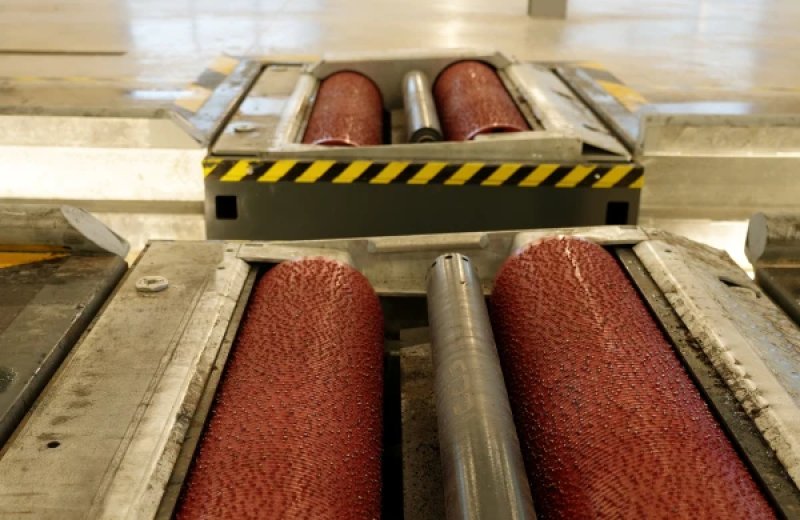
 Foto: BB.LV / на станции техосмотра
A resident of Latvia named Renars is puzzled as to how the same car can show completely different results for exhaust gas checks at different inspection points. In a short period, his diesel Volkswagen minibus failed the inspection twice in Ventspils but received a positive assessment in Kuldiga without any issues, reports the show Degpunktā ([TV3](https://tv3.lv/degpunkta/degpunkta-dazadi/vini-tikai-iekase-naudu-katra-pilseta-atskiras-tehniskas-apskates-rezultati-virietis-neizpratne/)). According to the man, he has been using the car for several years and previously passed the technical inspection in Riga regularly without serious problems. However, about a month ago, due to work circumstances, he decided to undergo the inspection in Ventspils. There, the device for measuring the number of solid particles in the exhaust showed four million particles. The permissible limit is one million. "The employee says: you will have an expensive repair. You will have to replace the particulate filter," Renars said. The man returned to Riga and went to an auto service for diagnostics. The mechanic checked the car and reported that the DPF particulate filter was functioning properly and did not need replacement. After receiving a confirming document, Renars went back to the technical inspection in Ventspils the same day. But this time the result was even worse — the device showed ten million particles. "I show the employee that I just passed the diagnostics. And he says: you came, but you didn't change any filter. I explain that it doesn't need to be changed, here is the diagnostics. But the device shows ten million," recalls the driver. After the second failed attempt, the man decided to check the car in another city. The next day he went to Kuldiga. There, the measuring device showed only 900 thousand particles — a figure below the permissible limit. As a result, the Volkswagen successfully passed the technical inspection and received permission for operation for a year. The difference in results raised many questions for the car owner. "Now I ask: what is happening? How many pensioners have been caught in this, how many people have changed filters, and they cost thousands," Renars expressed his outrage. The man shared his story on social media. According to him, the publication sparked a wide response: other drivers also began to recount the differences in solid particle measurement results at technical inspection stations in different cities of Latvia. Renars believes that motorists should not have to pay again for the inspection if the measurements themselves are questionable. "We want our money back. Why should we pay for an additional service if their devices at the technical inspection are not calibrated? Maybe this is a scheme, maybe they are making business out of it, I don't know," he stated. Journalists from Degpunktā reached out to the Road Traffic Safety Directorate (CSDD) for clarification. CSDD representative Mārtiņš Malmeistar said that technical inspections in Latvia are conducted by accredited enterprises, but CSDD oversees their activities. According to him, statistics do not confirm that cars in Ventspils fail inspections more often than others due to particulate filters. On the contrary, in terms of the number of identified DPF defects, this point is below the national average. The difference in measurement results was explained by the CSDD representative as being due to the characteristics of the engine and exhaust system. "Everything depends on the vehicle itself, weather conditions, and how a person takes care of their car, since all the devices installed at all technical inspection stations are completely identical," Malmeistar said. He reminded that the particulate filter periodically undergoes a regeneration process, during which accumulated particles are burned off. If there are violations in the operation of the engine or exhaust system, the number of particles in the exhaust can significantly increase. At the same time, the CSDD representative acknowledged that with more than a million technical inspections per year, it is impossible to completely eliminate employee errors. For drivers who doubt the accuracy of the inspection results, the directorate recommends contacting the technical department of CSDD. There, disputed cases can be reviewed by independent experts. Additionally, motorists can undergo an additional inspection directly by CSDD experts at the central office in Riga. Thus, CSDD admits that the inspection results for one vehicle can vary significantly, but offers drivers who believe the measurements are erroneous to seek an independent assessment.
