

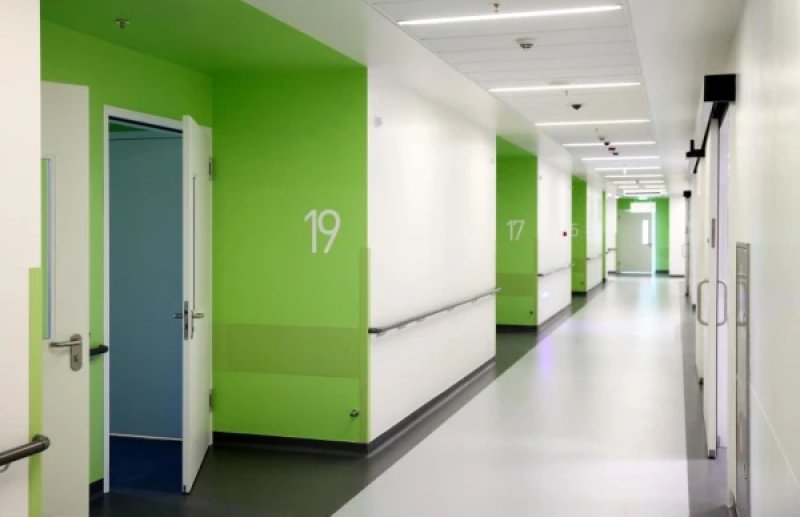
 Foto: BB.LV / больничный коридор
The Latvian Hospital Association (LHA) urges the government not to rush into approving the projected multi-million euro losses of Pauls Stradins Clinical University Hospital. According to the organization, the Ministry of Health has not sufficiently examined the reasons for the deterioration of the institution's financial results. As reported by the LETA agency, the association refused to approve the information report prepared by the ministry, which proposes to allow the hospital's negative impact on the general government sector budget balance to exceed five million euros. According to forecasts, this figure will reach 8.6 million euros in 2027 and 9.7 million euros in 2028. The Ministry of Health explains the financial difficulties by stating that state tariffs do not cover the actual cost of medical services. The LHA acknowledges the existence of such a problem but believes that it does not account for all the expenses of the specific hospital. Patient numbers are almost the same, but expenses have significantly increased One of the main objections from the association concerns the insufficient analysis of the complexity of patient treatments. The ministry points out that Stradins Hospital treats severely ill patients, including those with multiple conditions simultaneously, whose treatment requires significant resources. However, according to the LHA, the report lacks specific data on how many such patients are treated at the hospital and how their share is changing. According to the institution's report for 2025, 48,682 patients underwent inpatient treatment—almost the same number as the previous year. At the same time, the average length of stay in the hospital decreased to 4.94 days, while total expenses increased by 17.2 million euros. The association believes that such an increase cannot be explained solely by the complexity of diseases without a detailed analysis of the cost structure. The number of intensive care beds has sharply increased The LHA raised specific questions regarding the expansion of intensive care capacity. The average number of intensive care beds increased from 92 in 2024 to 143 in 2025—an increase of approximately 55%. At the same time, the number of patients receiving treatment in the relevant profiles increased by 111.3%, reaching 13,816. The association demands an explanation for such a significant increase in intensive care volumes and an assessment of the associated costs. In particular, it is proposed to compare the actual services provided with the funding volumes stipulated in contracts with the National Health Service. The LHA also reminds that Stradins Hospital provides assistance not only to patients with complex diseases but also to residents of Riga and the suburbs with less severe health issues. Therefore, expenses for treating different categories of patients need to be analyzed separately. Personnel costs have risen to 110.6 million euros Another point of contention is the hospital's personnel policy. In 2025, the average number of employees increased from 3,367 to 3,460. Thus, the staff grew by 93 workers. Personnel expenses for the same period increased from 104.9 million to 110.6 million euros, which is an increase of 5.7 million euros. Additionally, since February of last year, employees have begun to receive health insurance policies. The Latvian Hospital Association believes it is necessary to assess how the creation of new jobs and the introduction of additional benefits have impacted the institution's financial results. In the organization's conclusion, it is emphasized that expenses related to the personnel decisions of one hospital cannot be automatically explained by insufficient state tariffs when other medical institutions are forced to operate under limited funding conditions. Medications and medical supplies have become significantly more expensive Questions have also arisen regarding the increase in expenses for medications, medical supplies, and laboratory goods. In 2024, 67.1 million euros were spent on these purposes, while in 2025, the amount rose to 75.7 million euros. Expense Item 2024 2025 Personnel 104.9 million € 110.6 million € Medications, materials, and laboratory goods 67.1 million € 75.7 million € The LHA doubts that the increase in these expenses can be fully explained by inflation, as the number of inpatient patients has not significantly changed. The organization proposes to audit the procurement system, compare supplier prices, and assess the possibility of using equivalent but more economical products. Additional attention is suggested to be given to the increase in debts to suppliers and inventory levels. According to the association, this may indicate deficiencies in procurement planning and material usage. At the same time, the LHA notes that expenses for building maintenance, utilities, and patient meals decreased last year, although the ministry's report mentions the increase in such costs among the reasons for financial problems. The hospital had nearly 25 million euros in cash The Latvian Hospital Association also draws attention to the financial position of the institution at the end of 2025. At that time, the hospital had cash reserves of 24.8 million euros. Its short-term assets exceeded short-term liabilities by 9.7 million euros, and cash flow from operating activities was positive. According to the LHA, such indicators do not indicate a liquidity crisis that would require urgent solutions without a detailed examination of the reasons for the losses. However, the presence of cash alone does not imply the absence of financial problems: the association insists on the need to distinguish between current solvency and the long-term unprofitability of the hospital. Part of the losses may be related to legal disputes Another issue concerns the reserves formed by the hospital for legal disputes and doubtful receivables. According to the association, a significant portion of last year's losses may have been related to one-time expenses, including legal disputes and debt write-offs. Such costs, emphasizes the LHA, should be considered separately from the expenses for everyday patient treatment. A similar approach is proposed for investments in medical equipment and technology. The association acknowledges the importance of modernizing the hospital but believes that the corresponding expenses should not be included in the ongoing deficit of funding for medical services without separate analysis. Hospitals demand unified funding rules The Latvian Hospital Association emphasizes that the problem of insufficient tariffs affects the entire hospital sector, not just Stradins Hospital. At the same time, providing special financial conditions to one institution may affect the position of other hospitals that compete for medical staff, equipment, medications, and other resources. Therefore, the organization calls on the Ministry of Health to supplement the report with detailed data on patients, personnel expenses, procurement, investments, and already implemented cost-saving measures. The LHA also proposes to develop a unified funding model for hospitals based on actual costs and comparable performance indicators of medical institutions. Until such an analysis is conducted, the association considers it premature to allow Stradins Hospital to have a negative impact on the state budget exceeding five million euros in 2027 and 2028.
