

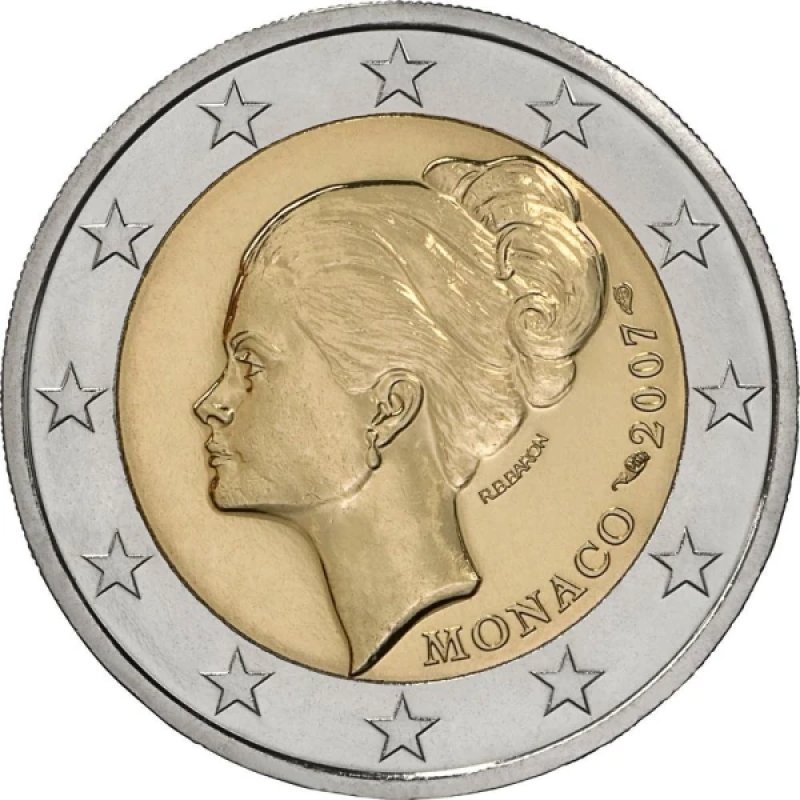
 Foto: BB.LV / Памятная двухевровая монета Монако 2007 года
In supermarkets, coins usually pass from hand to hand almost without attention. Meanwhile, paying attention to the change can be profitable: some two-euro coins have a collectible value that significantly exceeds their nominal value. However, specific features are crucial. An unusual design alone does not make a coin rare. **Grace Kelly: from 2 euros to 3,000** Among the most famous collectibles is the commemorative two-euro coin from Monaco issued in 2007. It commemorates the 25th anniversary of the death of Princess Grace Patricia, formerly Hollywood actress Grace Kelly. According to the European Central Bank, its mintage was only 20,001 pieces. This coin can be recognized by the portrait of the princess, the country name "MONACO," and the date 2007. To the right of the image is the artist's name "R.B. BARON" (in the photo). Experts estimate that such a coin is worth around 3,100 euros. However, there is an important "but": it was originally sold specifically to collectors and was not released into regular circulation. Therefore, finding it in everyday change would be extremely unusual. Formally, it is a full-fledged coin with a nominal value of 2 euros, and it can be used for payments, but it is unlikely that anyone would do so intentionally. **When a Mistake Makes a Coin Interesting** In addition to rare issues, the value of a coin can also be increased by errors, and finding such an example is much more realistic. A striking example is the so-called "fried egg" minting: in this case, the inner element of a one- or two-euro coin, differing in color, is misaligned, and its metal is partially displaced into the outer ring. The uneven shape indeed resembles a fried egg. Also interesting are a noticeable rotation of the coin's sides relative to each other or minting on an incorrect blank. The magazine "WirtschaftsWoche" mentions a possible value of up to 100 euros for the "fried egg" minting, up to 200 euros for cases of die rotation, and up to 650 euros for coins minted on foreign blanks. During coin production, two different metal parts are joined under high pressure and minted. Despite precise technology and careful control, some defective specimens still enter circulation. For example, the German commemorative two-euro coin "Saxony-Anhalt" from 2021 was minted on a blank intended for 1 euro. As a result, the colors compared to a regular two-euro coin were swapped: the outer ring became golden, while the inner part became silver. Additionally, such a specimen weighs only 7.50 grams instead of the usual 8.50. **This Little "S" Won't Make You Rich** How quickly an ordinary coin turns into an alleged sensation online is vividly demonstrated by the Greek specimens with a small letter "S" in one of the stars: they are repeatedly offered as valuable error mintings, reports the website zwei-euro.com. In reality, the letter stands for "Suomi," meaning Finland, where part of the Greek coins was produced. According to numismatic experts, this is an ordinary version with a mintage of 70 million pieces. The letter "S" alone is not a basis for an unusually high price. **Found a Valuable Coin? Don't Polish It!** Anyone who notices an unusual coin should first establish the country of issue, year, and motif. The ECB publishes a list of official commemorative issues of two-euro coins on its website. If after this you suspect that you have found a valuable coin, it is worth showing it to a specialized coin dealer or auction house. If the value is confirmed, direct sale or auctioning may be possible. Check in advance for possible commissions and under no circumstances should you wash or polish the coin: this can reduce its collectible value. Friction and polishing create tiny scratches, and the original shine of the minting is lost, writes Euronews.
