

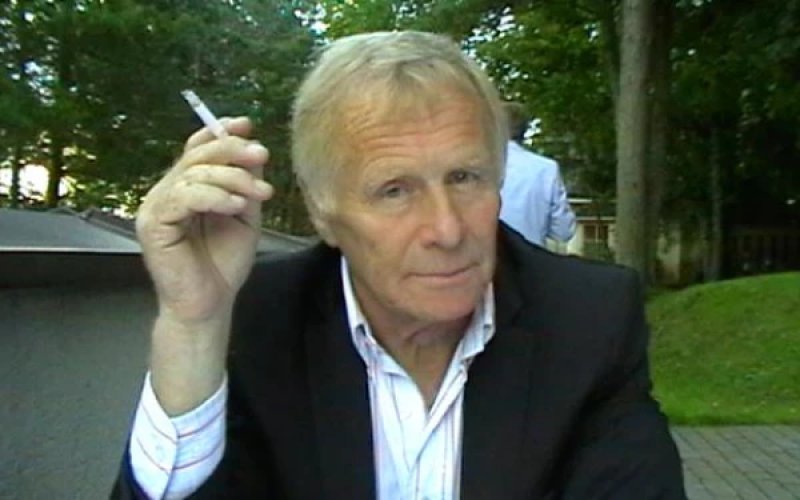
 Foto: BB.LV / Дозорцев
The role of Vladlen Leonidovich in the history of Latvia is underscored by the fact that he was one of those who voted for the Declaration of the Restoration of the Independence of the Latvian Republic on May 4, 1990. In 1988, he participated in the famous plenum of creative unions that laid the groundwork for the People's Front, and later became a member of its board, writes Andrey Shavrey on the LSM+ portal. However, his role in the history of Latvian culture is no less significant. It is enough to say that he was the literary co-editor of the legendary series "The Long Road in the Dunes" and he was the one who came up with the title of this cinematic epic. He considered himself primarily a poet. "He was a wonderful poet. May he rest in peace!" responded Latvian-Israeli poet Vladimir Frenkel to the passing of his colleague. "It’s unbearably sad! A great poet! My condolences to his loved ones. May his memory be bright..." wrote poet and editor Yuri Kasianich. "What a loss! I mourn and offer my condolences to everyone who loved this incredibly talented person!" said former television star and ex-deputy of the Riga City Council Irina Vinnik. "Today my dear friend, poet, writer, playwright, politician Vladlen Dozortsev has passed away," wrote Janis Jurkans, the first Minister of Foreign Affairs of Latvia after the restoration of independence. "There are losses that are especially difficult to talk about. This person was such a big part of my life that when I try to speak about him, my words seem to falter. Dear Vladlen! You were my friend, my teacher, my mentor. A person from whom I learned both politics and oratory. When speaking of you, I always used the word 'rock' — the firmness of your personality, the strength of your mind, and your human scale. Your significance for the People's Front cannot be measured by positions or speeches. You knew how to reach out to the Russian-speaking residents of Latvia and convince them to support the People's Front. At that historic moment, people believed your word. And I know how much that meant for Latvia at the time. Later we created 'Harmony' together. We were united by our common work and the belief that people in this country should be able to speak to each other and live together. This belief is still important to me. Today I want to thank you above all for your friendship, for your trust, for everything I learned from you, and for what I may not always be able to express in words. You were a huge part of my political and human life and will always remain so. Towards the end of your life, you lost your sight, but you always saw better with your heart than with your eyes. May your path be bright, Vladlen!" Vladlen Dozortsev was born on July 3, 1939, in Roslavl, Smolensk Oblast, RSFSR. His mother was an agronomist by profession, and his father worked as a director of an enterprise before the war. In 1947, the Riga period in Vladlen Dozortsev's life began. He initially studied at the 26th secondary school near the Agenskalns market. He graduated from school in 1956, during the campaign for the development of virgin lands, and went to Kazakhstan on a Komsomol ticket to work on the construction of the Turgai bauxite mine. In 1958, he entered the Faculty of Philology at the University of Latvia, graduating in 1963. During his studies, he published his first poems. He worked for Latvian newspapers and Latvian television, where he created more than ten documentary films. Later, he became a member of the script committee of the Riga Film Studio. His scripts were used for feature films such as "Wait for John Grafton," "The House Without an Exit," "Bypass," "An Alien Case," and others. Kilobyte of culture: Dozortsev and his final book of lyrics – "That's It, I Quit" September 7, 2016, 7:04 Author of poetry collections "Highway" (1965), "Chase" (1972), "The Sadness of Free Flight" (1979), "The Year Two Thousand" (2000), "Awaiting Judgment" (2007), "Personal Code" (2012), as well as the final book of selected poetry "Burn the Rest" (2016). In 1982, his novel "The Lone Shooter on the Running Target" was published, which later became part of the book "Four Incidents." During his time at the Riga Film Studio, he wrote two plays that long struggled to receive censorship approval — "The Last Visitor" and "Breakfast with Strangers." But in 1985, one of them was staged at the Bolshoi Drama Theater in Leningrad by the great Georgy Tovstonogov, and after that, both plays spread across the country like wildfire: "The Last Visitor" was staged in 130 theaters, while "Breakfast with Strangers" in 60! The plays were also staged in Japan, Cuba, West and East Germany, Bulgaria, and the USA. In 1987, Dozortsev became the editor-in-chief of the literary magazine "Daugava"; under his leadership, the monthly circulation of the publication reached 109,000 copies. After the restoration of the independence of the Latvian Republic, Vladlen Leonidovich was granted citizenship for special merits. He was one of the founders of the Harmony Party, through which he served as a deputy in the 6th Saeima from 1995 to 1998. In 2009, Dozortsev's first memoir "The Present Past Time" was published, and in 2017, the second, "Another Jurkans," in both Russian and Latvian. In collaboration with Raimonds Pauls, he created several dozen songs for Laima Vaikule, Maria Naumova, Valery Leontiev. In recent decades, he lived in Jurmala. "I can call myself a lone shooter on a running target. I am, to some extent, a hermit-hunter in life. I am passionate, and I want to hit the target. And 'The Lone Shooter on the Running Target' is practically an autobiographical novel. Perhaps what I did not dare to do in life, I dared to put on paper. Some complexes in life always turn into heroism on paper. But I, like my hero, made some kind of heroic attempt. Maybe I just didn’t go that far," said Dozortsev. And still, first and foremost, Vladlen Leonidovich was a poet, and a poet of great caliber. "Take a pen. Draw squares. Fill them in — write the day, month, year. Add five digits of an unimaginable riddle. Remember them — your personal code. Put it in an envelope, send it to the great God. Perhaps he will deign to read your strange code, in which there is little use, but still, it is quietly believed that there is one."
