

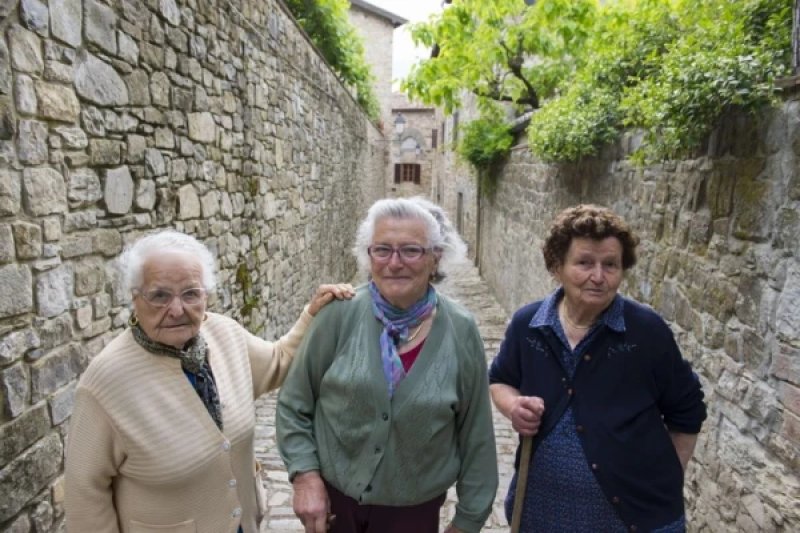
 Foto: BB.LV / долгожители
## Growing to a hundred without aging The data obtained indicate that the settlement may claim the status of a new "blue zone" — a region where people live extraordinarily long lives. Other such zones include, for example, the Japanese island of Okinawa and the Nicoya Peninsula in Costa Rica. Scientists have been attracted by the extraordinarily high concentration of centenarians in Bolotana. In 2024, in a village with a population of about 2,300, there were six people aged 100 and older. The number of centenarians here is approximately 11 times higher per capita than in the USA. The previously identified "blue zone" on the island is famous for the extraordinarily high life expectancy of men; however, in Bolotana, another group has come to the forefront — women. According to researchers' estimates, 13.8% of women here live to be 100, while the figure for the rest of Italy is about 3.5%. Local women who reach the age of 70 can expect nearly 21 more years of life. In the global longevity ranking, women from Bolotana are surpassed only by those from Hong Kong — both in terms of life expectancy after 70 and the likelihood of living to 100. ## Reasons for the Longevity of Bolotana Women Thus, Bolotana has one of the longest-living female populations in the world. Scientists have suggested that factors such as diet, physical activity, social connections, family support, and genetics play a role in this. The village is located in the mountains, so locals walk a lot on rough terrain and primarily get around without cars. Most of the food is grown locally, particularly olive oil, which is rich in healthy fats. Families often live close to each other, and social isolation is a rare phenomenon. According to researchers, Bolotana has formed a close-knit community where people care for one another. ## What about Latvia? The Central Statistical Bureau of Latvia does not have statistics on centenarians. However, they have counted the number of local residents over 85 years old. This year, there were 56,278 such individuals, or 3.1 percent of the total population.
