

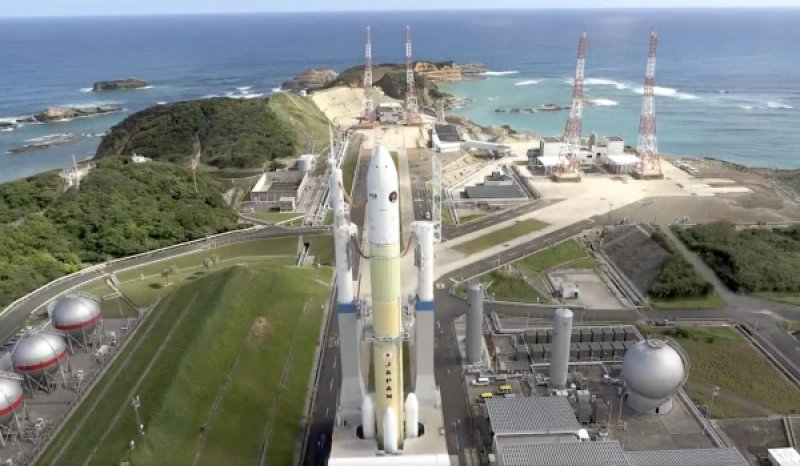
 Foto: BB.LV / ракета
A rocket H3 with a research device heading to Mars' moons successfully launched from the Tanegashima spaceport in Japan. This was reported by the LETA agency, citing DPA. The unmanned mission Martian Moons eXploration (MMX) is led by the Japan Aerospace Exploration Agency (JAXA). One of its key components will be the rover Idefix, jointly developed by specialists from Germany and France. It is expected that after approximately a year of flight, the spacecraft will reach Mars in 2027 and enter orbit around the planet. ## Landing without a landing module At the end of 2028 or the beginning of 2029, the rover Idefix is planned to be dropped onto the surface of Phobos from a height of about 40 meters. Unlike conventional space landing modules, it will reach the surface in free fall. This will be possible due to the rover's small mass and the extremely weak gravity of the moon. According to the German Aerospace Center (DLR), Idefix weighs only 25 kilograms. Its size is comparable to a bottle crate, yet it is equipped with many instruments typically found on significantly larger research devices. After landing, the rover is expected to spend about 100 days on Phobos studying its surface. If the mission is successful, Idefix will become the first rover to operate on one of Mars' moons. ## What is known about Phobos Mars has two natural satellites — Phobos and Deimos. Together with Earth's Moon, they are the only natural satellites of the inner planets of the Solar System. Both moons are significantly smaller than the Moon and have irregular shapes. The width of Phobos at its widest point is less than 27 kilometers, while the maximum diameter of Deimos is about 15 kilometers. Conditions on Phobos are extreme: its surface temperature can range from minus 150 to plus 30 degrees Celsius. ## Scientists want to determine the origin of Mars' moons One of the main tasks of the MMX mission is to establish how Phobos and Deimos came to be. Scientists consider two main hypotheses. According to the first, the moons were once asteroids that Mars captured with its gravity. The second version suggests that they formed from debris ejected into space after a powerful collision with the planet. Studying the surface of Phobos and analyzing samples of its soil may help determine which of the hypotheses is closer to the truth. Additionally, scientists hope to gain new insights into the formation of Mars and the early history of the Solar System. The results of the mission may also be useful for research into the conditions related to the emergence of life. The return of soil samples from Phobos to Earth is scheduled for 2031.
